IB Syllabus focus: 'Neurotransmission and chemical messengers influence human behaviour and should be applied within contexts.'
Neural communication depends on chemical signals that shape thought, emotion, movement, and memory. Understanding neurotransmission helps explain how biology influences behavior in mental health, stress responses, and social interaction.
How neurons communicate
When one neuron communicates with another, it does so through neurotransmission.
Neurotransmission: The process by which neurons send chemical signals across synapses to influence the activity of other cells.
This process begins when an electrical impulse travels down the neuron to the axon terminal. At the terminal, the neuron releases neurotransmitters into the synapse.
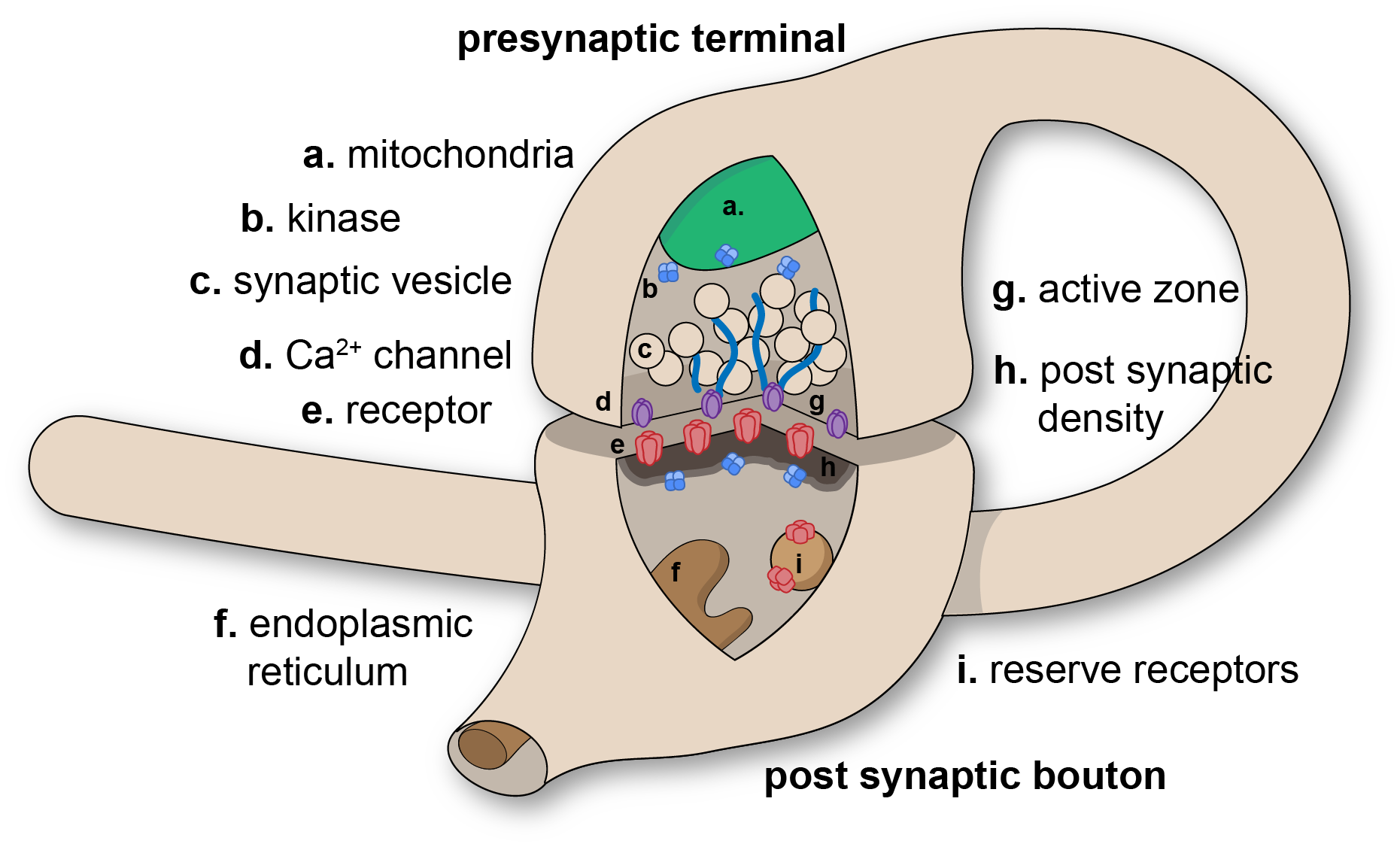
Diagram of a chemical synapse showing how neurotransmitters are released from synaptic vesicles in the presynaptic terminal, diffuse across the synaptic cleft, and bind to receptors on the postsynaptic membrane. This provides a concrete visual map for the sequence of events described in synaptic transmission, including where reuptake and receptor binding occur. Source
Neurotransmitter: A chemical messenger released by a neuron that binds to receptors on another cell and changes its activity.
Neurotransmission usually follows a sequence:
an action potential reaches the axon terminal
vesicles release neurotransmitters into the synaptic cleft
neurotransmitters bind to specific receptors on the postsynaptic cell
the receiving neuron becomes more or less likely to fire
the signal ends through reuptake, enzymatic breakdown, or diffusion
The effect of a neurotransmitter depends on the receptor it binds to. Some signals are excitatory, meaning they increase the chance that the next neuron will fire. Others are inhibitory, meaning they reduce that chance.
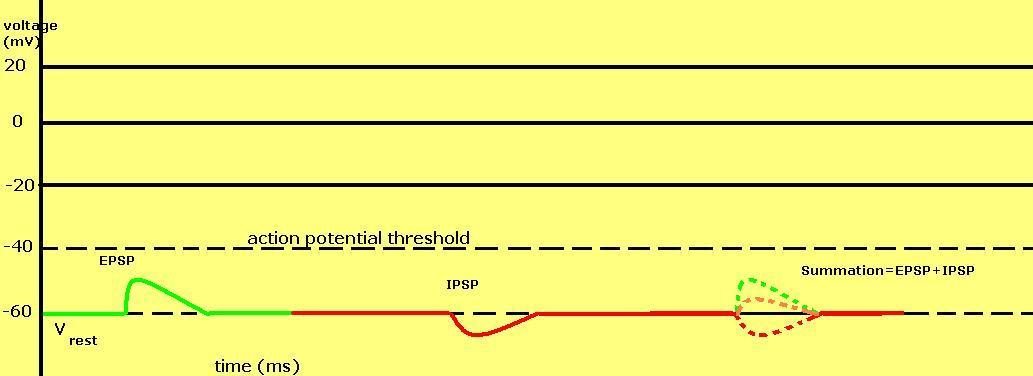
Graph of an excitatory postsynaptic potential (EPSP), an inhibitory postsynaptic potential (IPSP), and their summation over time. It illustrates how excitation depolarizes the membrane toward threshold while inhibition hyperpolarizes it away from threshold, and how combined inputs integrate to determine whether an action potential is triggered. Source
Human behavior is influenced by the balance of excitation and inhibition across large neural networks, not by a single chemical acting alone.
Disruptions to neurotransmission can affect mood, attention, memory, movement, and decision-making. For this reason, psychologists and neuroscientists often study neurotransmitters when explaining behavior in clinical, cognitive, and health-related contexts.
Chemical messengers beyond the synapse
Not all chemical communication happens directly between neurons. Some chemical messengers are hormones, which are produced by endocrine glands and carried in the bloodstream.
Hormone: A chemical messenger released by an endocrine gland into the bloodstream that affects target organs or cells.
Compared with neurotransmitters, hormones usually act more slowly but can have longer-lasting effects. Neurotransmitters are often linked to rapid communication in the nervous system, while hormones help regulate broader bodily states such as stress, energy use, and reproduction. Both types of chemical messenger influence behavior, so IB Psychology expects students to apply them in real contexts rather than treat them as isolated facts.
Key neurotransmitters in human behavior
Serotonin
Serotonin is commonly associated with mood, but it also affects sleep, appetite, and some aspects of cognition. Low or dysregulated serotonin activity has been linked to depression and anxiety-related symptoms. However, IB students should avoid overly simple claims such as “low serotonin causes depression.” Human behavior is complex, and serotonin interacts with other neurotransmitters, life experiences, and situational stressors.
Many antidepressant drugs aim to increase the availability of serotonin in the synapse. This shows how knowledge of neurotransmission can be applied in a health context.
Dopamine
Dopamine is involved in reward, motivation, attention, and movement. It is often discussed in relation to pleasure, but its role is broader: dopamine helps the brain identify what is important and worth pursuing. Dysregulated dopamine activity has been linked to addiction, schizophrenia, and movement disorders.
In behavioral contexts, dopamine helps explain why rewarding experiences can strengthen repeated actions. This makes it relevant to habits, substance use, and reinforcement.
Acetylcholine, GABA, and glutamate
Acetylcholine is important for learning, memory, and muscle activation. Reduced acetylcholine functioning has been linked to memory impairment, especially in disorders such as Alzheimer’s disease.
GABA is the brain’s main inhibitory neurotransmitter. It helps calm neural activity and is important in anxiety regulation. If inhibitory control is reduced, a person may become more vulnerable to overarousal.
Glutamate is the brain’s main excitatory neurotransmitter. It is involved in learning and memory, but too much excitation can be harmful. These examples show that healthy behavior depends on balance rather than simply having “more” or “less” of a neurotransmitter.
Applying chemical messengers within contexts
Mental health and treatment
Chemical messengers are especially important in clinical psychology. For example:
serotonin is often discussed in depression
dopamine is often discussed in addiction and psychotic symptoms
GABA is often discussed in anxiety
acetylcholine is often discussed in memory disorders
Drugs can change neurotransmission by increasing or decreasing a chemical signal. Some act as agonists, increasing the effect of a neurotransmitter, while others act as antagonists, reducing its effect. This helps explain why medication can alter behavior, emotion, and cognition.
Stress and social behavior
Hormones are highly relevant in the context of stress. Adrenaline prepares the body for immediate action by increasing heart rate and alertness. Cortisol supports longer-term stress responses by mobilizing energy.
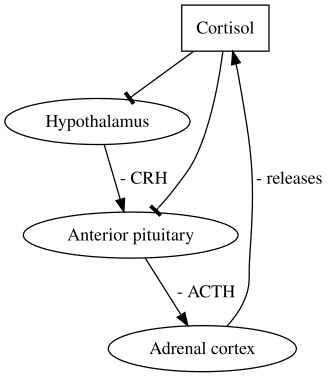
Labeled schematic of the hypothalamic–pituitary–adrenal (HPA) axis, showing CRH release from the hypothalamus, ACTH release from the anterior pituitary, and cortisol release from the adrenal cortex. The negative feedback arrows help explain why cortisol is both a stress hormone and a regulator of its own production over time. Source
In the short term, these responses can be adaptive. If cortisol remains elevated for long periods, however, attention, sleep, and memory may be negatively affected.
Chemical messengers also influence social behavior. For example, oxytocin has been linked to bonding, trust, and attachment. Still, its effects depend on context. Oxytocin does not simply “cause trust” in every situation; social setting, relationship history, and interpretation of cues all matter.
Why context matters
A strong IB answer should show that neurotransmission does not work in a simple one-cause-one-effect way. The influence of chemical messengers depends on:
receptor type and receptor location
interaction with other neurotransmitters or hormones
dose and duration of the signal
individual differences
the social or environmental context in which behavior occurs
This is why psychologists apply neurotransmission within specific contexts such as mental health, stress, learning, or social relationships, rather than making broad claims that one chemical fully explains behavior.
Practice Questions
Question 1 (2 marks) State one difference between a neurotransmitter and a hormone.
1 mark for identifying that a neurotransmitter is released by a neuron and acts across a synapse.
1 mark for identifying that a hormone is released by an endocrine gland and travels through the bloodstream, usually with slower and longer-lasting effects.
Question 2 (6 marks) Explain how one neurotransmitter or chemical messenger influences human behavior in one context.
1 mark for naming a relevant neurotransmitter or hormone.
1 mark for identifying a relevant context such as mental health, stress, memory, addiction, or social behavior.
1–2 marks for accurate knowledge of how the chemical messenger works, such as receptor binding, excitation/inhibition, or hormonal action.
1–2 marks for clearly explaining its influence on behavior in that context.
1 mark for acknowledging complexity, such as interaction with other factors or the importance of context. Maximum 6 marks.
FAQ
SSRIs can increase serotonin availability in the synapse within hours, but symptom improvement often takes longer.
This delay likely happens because:
receptor sensitivity needs time to adjust
neural networks gradually change their activity
mood involves many systems beyond serotonin alone
So the immediate chemical change is not the same as an immediate behavioral change.
Direct measurement is difficult because the brain is protected and invasive methods are limited.
Researchers often rely on indirect methods such as:
PET scans using radioactive tracers
blood or saliva measures for some related chemicals
drug studies that infer neurotransmitter activity from behavior changes
This means evidence about neurotransmitters in humans is often probabilistic rather than perfectly direct.
The blood-brain barrier is a protective filtering system that limits which substances can pass from the bloodstream into the brain.
It matters because:
many hormones circulate in blood but do not enter the brain easily
drugs designed to affect neurotransmission must be able to cross it
it helps protect neural tissue from toxins
This is one reason why not every chemical in the body has the same effect on behavior.
Tolerance happens when the brain adapts to repeated chemical stimulation.
Possible changes include:
fewer receptors being available
receptors becoming less responsive
compensatory changes in neurotransmitter release
As a result, the same dose has a smaller effect over time, and a person may need more of the drug to produce a similar behavioral response.
They differ mainly in how they reach and affect target cells.
Peptide hormones usually bind to receptors on the cell surface and trigger internal signaling pathways.
Steroid hormones can pass through cell membranes and bind to receptors inside the cell.
Steroid effects are often slower to begin but may last longer because they can influence gene expression. This helps explain why some hormonal effects on behavior are immediate while others develop more gradually.