IB Syllabus focus: 'The cognitive approach studies mental processes, viewing the mind as an information processor between stimulus input and behavioural output.'
This subtopic explains the basic logic of the cognitive approach: psychologists understand behavior by examining the internal processes that receive, transform, store, and use information.
Understanding Mental Processes
The cognitive approach argues that behavior cannot be understood only by looking at observable actions. Between a stimulus and a response, people attend to information, interpret it, compare it with what is already stored, and decide how to act. These hidden activities are the focus of cognitive psychology.
Mental processes: Internal operations involved in acquiring, interpreting, storing, and using information, such as perception, attention, memory, language, thinking, and decision-making.
Because mental processes are internal, they are not usually observed directly. Instead, psychologists infer them from measurable behavior, such as the speed, accuracy, and pattern of a person’s response. This makes the approach scientific without claiming that every part of the mind can be seen directly.
The Mind as an Information Processor
A central assumption of the approach is that the mind works as an information processor. This does not mean the mind is literally a computer. It means cognition can be studied as a set of operations that act on incoming information and produce an output in the form of thought or behavior.
Information processing: The idea that cognition can be understood as a sequence of processes in which information is received, transformed, stored, retrieved, and used to guide responses.
In simple form, the model can be described as:
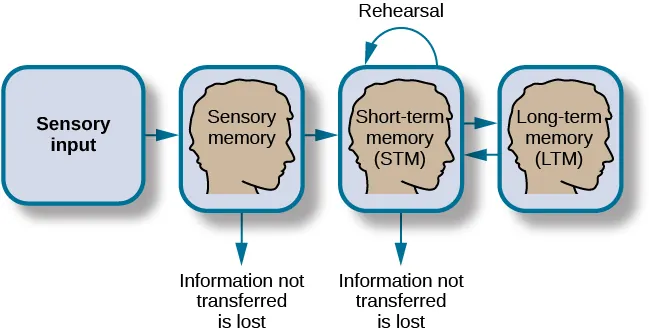
This figure illustrates a classic information-processing (multi-store) model of memory: sensory input passes through sensory memory to short-term memory and can be transferred to long-term memory, with retrieval flowing back to short-term memory. The arrows and labels (e.g., rehearsal, loss of non-transferred information) make the idea of staged processing concrete and testable. Source
Stimulus input: information enters through the senses.
Processing: the information is selected, encoded, interpreted, and sometimes stored.
Behavioral output: a response is produced, such as speaking, remembering, choosing, or moving.
Psychologists often separate processing into smaller operations so they can study them more clearly:
Attention selects which information is processed.
Perception gives meaning to sensory input.
Encoding changes experience into a usable mental form.
Storage keeps information available over time.
Retrieval brings stored information back when needed.
This framework highlights that the same input does not always lead to the same output. Different people may notice different details, interpret the same event differently, or retrieve different memories. The crucial explanation lies in what happens during processing.
Mental Processes Between Stimulus and Response
The cognitive approach rejects a purely stimulus-response view of human behavior. Instead, it argues that internal processes mediate between what happens in the environment and how a person responds.
A loud noise, for example, may be ignored, judged as dangerous, or recognized as familiar depending on attention, perception, and memory.
Mediational processes: Internal mental activities that intervene between an external stimulus and an observable response.
These mediational processes help explain why human behavior is flexible rather than automatic. People can interpret meaning, predict outcomes, solve problems, and modify their behavior based on past experience. This is one reason cognitive psychology focuses on how information is handled, not just on what behavior is observed at the end.
Core Assumptions of the Cognitive Approach
Internal processes can be studied scientifically
Although the mind cannot be opened and inspected directly, researchers can test models of cognition by manipulating input and measuring output. If a change in the type, amount, or timing of information changes performance, psychologists can make reasoned claims about the processes involved. Common indicators include reaction time, accuracy, recall, recognition, and error patterns.
People actively process information
Humans are not passive receivers of stimulation. They select what to attend to, organize incoming material, and interpret it in relation to goals and expectations. This means cognition is active and constructive. Perception, memory, and thinking are shaped by the way information is processed, not merely by the information itself.
Models simplify complex cognition
Many cognitive explanations divide mental activity into stages such as input, encoding, storage, retrieval, and response. Stage models are useful because they simplify complex mental activity into parts that can be investigated. They also help researchers generate precise hypotheses about where a problem or change in performance may occur. However, the stages are best understood as a model. In real life, some processes overlap or occur very rapidly.
Why This Perspective Is Useful
Viewing the mind as an information processor allows psychologists to explain both cognition and behavior. It helps answer questions such as:
Why two people remember the same event differently
Why attention improves some responses and reduces others
Why decision-making changes when information is incomplete or overloaded
Why performance depends on how information is encoded and retrieved
This perspective is valuable because it links observable performance to underlying mental activity. Instead of treating behavior as a simple endpoint, cognitive psychology treats it as evidence of how information has been processed.
Strengths and Cautions
A major strength of this approach is that it produces testable models. Researchers can make predictions about what should happen if attention is divided, if information is presented in a different order, or if retrieval cues are changed. This supports controlled laboratory research and precise theory building.
At the same time, the model has limits. Human thinking is not always neat, linear, or fully conscious. Emotional state, motivation, and context may alter processing, and some mental operations happen simultaneously rather than one after another. The information processing approach is therefore best seen as a powerful framework for explaining cognition, rather than a complete or literal map of the mind.
Practice Questions
Question 1 (2 marks) State one way the cognitive approach differs from a simple stimulus-response explanation of behavior.
1 mark for stating that the cognitive approach includes internal or mental processes.
1 mark for stating that these processes occur between stimulus input and behavioral output, or that they influence the response produced.
Question 2 (6 marks) Explain the information processing view of the mind in the cognitive approach.
1 mark for identifying the mind as an information processor.
1 mark for describing stimulus input.
1 mark for explaining processing of information, such as attention, perception, encoding, storage, or retrieval.
1 mark for linking processing to behavioral output.
1 mark for explaining that mental processes mediate between stimulus and response.
1 mark for noting that psychologists infer these processes from measurable behavior, such as accuracy, recall, or reaction time. Accept equivalent answers.
FAQ
Bottom-up processing starts with sensory input. The person builds a perception from the data that enters through the senses.
Top-down processing uses expectations, context, and prior knowledge to interpret that input. Most real cognition combines both, which is why the same stimulus can be understood differently in different situations.
A bottleneck is a stage where too much information competes for limited mental capacity. When this happens, performance slows, accuracy drops, or some information is ignored.
Researchers look for bottlenecks in tasks involving divided attention, rapid decision-making, or multitasking. Bottlenecks help explain why people often struggle to process several demanding streams of information at once.
Interference tasks deliberately add competing information, such as distracting words, sounds, or a second task. If performance changes, researchers infer that two processes are relying on the same limited resources.
This is useful because the mental process itself cannot be seen directly. Interference shows where processing becomes slower, more effortful, or less accurate.
Ambiguous stimuli can be interpreted in more than one way, such as unclear images or sentences with two possible meanings. They let psychologists examine how people move from raw input to interpretation.
Because the sensory input stays constant while interpretations vary, ambiguous stimuli highlight the role of expectations, context, and prior experience in cognition.
Yes. Repeated practice can make some tasks faster, more stable, and less effortful. A person may rely less on slow, deliberate control and more on rapid, efficient routines.
However, practice does not make every task automatic. New, complex, or conflicting information can still require conscious attention and active monitoring.