IB Syllabus focus: 'Cognitive models, including information processing, memory and language models, explain cognitive processes and behaviour.'
Cognitive models are simplified representations of how the mind works. In IB Psychology, they help explain unobservable mental processes by organizing evidence about how people think, remember, understand language, and act.
Understanding cognitive models
Cognitive psychology studies mental processes that cannot be directly observed. Because thoughts, memories, and language operations are hidden, psychologists build models to represent how information is taken in, transformed, stored, and used.
Cognitive model: A simplified representation of internal mental processes used to explain and predict cognition and behavior.
A cognitive model is not a perfect copy of the mind. Instead, it is an abstract explanation based on research evidence. Models often show stages, systems, or interacting parts that together produce behavior.
Cognitive models are used to:
describe mental processes
explain patterns in behavior
generate testable predictions
organize research findings into a clear structure
Core assumptions
Most cognitive models assume that people are active processors of information. Stimuli are not just received passively; they are selected, interpreted, and linked to existing knowledge. This means the same external event may lead to different responses depending on internal processing.
Because mental processes are not directly visible, psychologists infer them from observable measures such as:
accuracy
recall
reaction time
error patterns
Information processing models
Information processing models compare the mind to a system that receives input, carries out processing, and produces output.
This analogy is useful because it treats cognition as organized and rule-based, even if real human thinking is more flexible than a machine.
Information processing model: A cognitive model that explains behavior by describing how information is received, transformed, stored, and used by the mind.
These models often divide cognition into stages such as attention, encoding, storage, retrieval, and response selection. Some models suggest serial processing, where one stage must be completed before the next begins. Others allow parallel processing, where several operations occur at the same time.
Information processing models help explain why performance changes under different task demands. If one part of the system has limited capacity, performance may slow down or errors may increase. This is especially useful for explaining differences in decision-making, problem-solving, and multitasking.
A key strength of these models is that they turn mental activity into something that can be tested experimentally. Researchers can manipulate task difficulty and then examine whether behavior changes in the way the model predicts.
Memory models
Memory models explain how information is encoded, stored, and later retrieved. They are central to the cognitive approach because memory is not treated as a single unitary process. Instead, models divide memory into components with different roles.
One broad approach separates memory into sensory memory, short-term or working memory, and long-term memory.
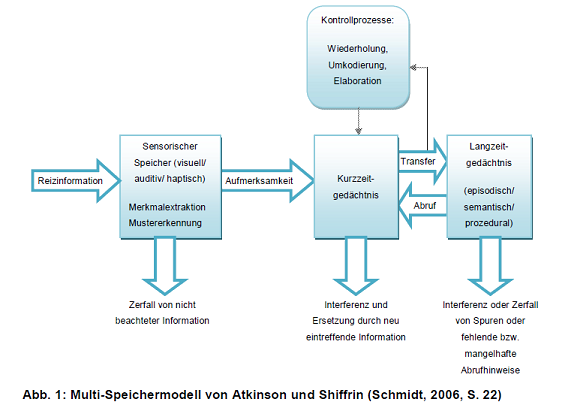
Diagram of the Atkinson–Shiffrin (multi-store) memory model, showing memory as multiple stores rather than a single unit. It supports the core cognitive-model claim that encoding, storage, and retrieval can be analyzed as separable components with information flowing between them. Source
This helps explain why some information disappears almost immediately while other information can be retained for long periods. A more detailed approach is the working memory model, which proposes that short-term memory is made up of multiple systems rather than one simple store.
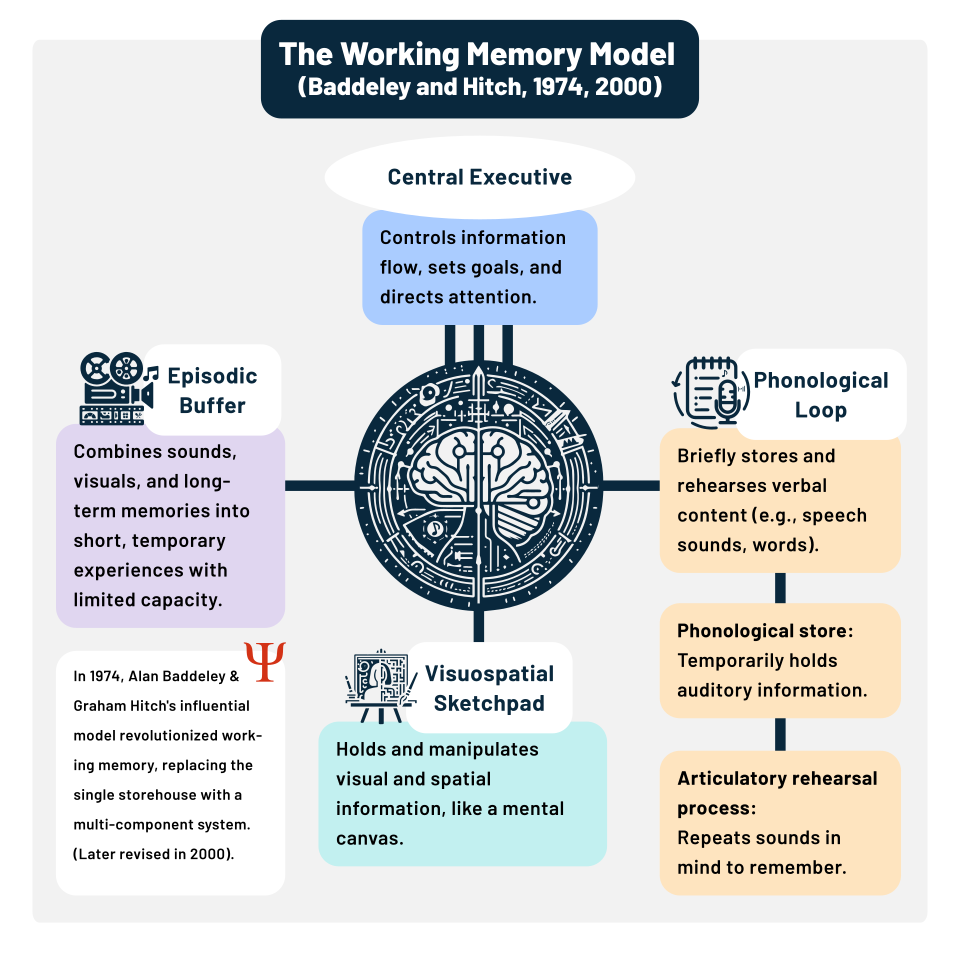
Baddeley and Hitch’s working memory model (revised to include the episodic buffer) showing the central executive coordinating multiple specialized subsystems. The diagram helps distinguish storage/manipulation functions (e.g., phonological vs. visuospatial processing) and illustrates how models explain limits in attention and capacity. Source
Memory models are useful because they help explain:
why rehearsal often improves retention
why distraction weakens immediate recall
why meaningful organization supports learning
why retrieval can fail even when material was once learned
They also show that memory is often constructive rather than a literal replay of experience. Recall may involve rebuilding information from stored fragments, expectations, and context. This means memory models can explain both successful recall and distorted recall.
Language models
Language models explain the mental processes involved in understanding and producing language. They focus on how people recognize sounds or written symbols, assign meaning, use grammar, and generate speech.
Many language models distinguish between different levels of processing:
phonological processing for sounds
syntactic processing for grammar
semantic processing for meaning
pragmatic processing for intended meaning in context
Some models propose that language comprehension moves from lower-level input to higher-level meaning in a step-by-step way. Other models are more interactive and suggest that context, expectations, and prior knowledge influence interpretation from the start.
Language models help explain behaviors such as fast word recognition, ambiguity resolution, and fluent sentence production. They also show that language is closely connected to other cognitive systems, especially memory and attention.
Why cognitive models matter
Cognitive models are important because they make invisible mental activity open to scientific investigation. Instead of simply describing behavior, they offer explanations for the processes that produce behavior.
They also help researchers ask more precise questions. For example, if a model proposes separate stages, psychologists can test whether changing one stage affects performance while another remains stable. This makes it possible to compare competing explanations rather than relying only on broad descriptions.
In addition, cognitive models have practical value. Memory models can inform revision strategies and learning methods. Information processing models can help explain overload in complex tasks. Language models can clarify why some types of comprehension are automatic while others require effort.
Strengths and limitations
A major strength of cognitive models is that they provide clear and structured explanations for complex mental activity. Because they are often specific, they can be tested, revised, or rejected in light of evidence. This makes them especially useful for building cumulative knowledge in psychology.
However, cognitive models are always simplifications. They may leave out emotion, motivation, or context if they focus too narrowly on mental mechanisms. Some models also depend heavily on analogies, such as comparing the mind to a computer, which can be helpful but incomplete.
Another limitation is that internal processes are inferred rather than directly observed. As a result, more than one model may sometimes explain the same behavior. Strong evaluation therefore depends on converging evidence from experiments, performance patterns, and careful comparison of alternative models.
Practice Questions
Question 1 [3 marks] Define the term cognitive model and identify one purpose of using cognitive models in psychology.
1 mark for stating that a cognitive model is a simplified representation or explanation of internal mental processes.
1 mark for making clear that it is used to explain cognition or behavior.
1 mark for identifying one purpose, such as organizing research findings, generating predictions, or explaining unobservable processes.
Question 2 [6 marks] Explain how one type of cognitive model helps psychologists understand cognitive processes and behavior.
1 mark for identifying an appropriate type of model, such as an information processing, memory, or language model.
1–2 marks for outlining the main components or structure of the chosen model.
1–2 marks for explaining how the model represents a cognitive process, such as encoding, retrieval, comprehension, or response selection.
1–2 marks for linking the model to observable behavior, such as recall performance, reaction time, errors, or language use.
Full marks require a clear explanation rather than a list of features.
FAQ
They are used to show the flow of information through a system.
Boxes usually represent stores, stages, or processes. Arrows show the direction of information movement or interaction between components.
This visual format is useful because it:
simplifies complex ideas
makes predictions easier to understand
helps researchers compare different models
A diagram is not the model itself. It is a shorthand representation of the theory behind it.
A stage model explains cognition as a sequence of separate steps or components, often shown in order.
A connectionist model explains cognition through networks of simple units working together. Instead of one fixed path, processing emerges from patterns of activation across the network.
Stage models are often easier to test and teach.
Connectionist models are useful when psychologists want to explain flexible, distributed processing, especially when several pieces of information influence behavior at once.
Mental processes cannot usually be observed directly, so psychologists must infer them from behavior.
This means different models may make similar predictions for the same task. For example, two models might both explain slower performance but propose different underlying mechanisms.
Researchers deal with this by:
designing more precise experiments
testing unusual or difficult cases
looking for patterns one model predicts better than another
A model becomes stronger when it explains more findings with fewer assumptions.
A computer simulation turns a cognitive model into a working system with explicit rules.
This helps because vague ideas must be made precise. If a simulation cannot produce the behavior the model predicts, the theory may need revision.
Simulations are especially useful for:
checking whether a model is internally consistent
comparing outputs with human performance
testing whether small rule changes alter behavior
They do not prove a model is true, but they can show whether it is logically workable.
They change because new evidence often reveals that older models are too simple.
For example, a model may work well for basic tasks but fail to explain errors, individual differences, or more realistic situations. Researchers then revise the model or create a new one.
Models also change when:
methods improve
new tasks are developed
competing theories explain findings better
In psychology, a good model is not one that never changes. It is one that can be improved as evidence becomes more detailed.