IB Syllabus focus: 'Classical and operant conditioning explain how behaviours form through stimulus-response links, reinforcement and punishment.'
Behaviorism focuses on learned behavior rather than hidden mental processes. In IB Psychology, conditioning matters because it shows how environmental experiences shape habits, emotional reactions, and patterns of behavior.
Behaviorism as a learning approach
Behaviorism is a psychological approach that argues behavior is mainly learned from the environment. Early behaviorists wanted psychology to be scientific, so they focused on observable behavior instead of thoughts or feelings that could not be directly measured.
Behaviorism: A psychological approach that explains behavior in terms of learning through interaction with the environment, especially through associations, reinforcement, and punishment.
Behaviorism is closely linked to researchers such as John Watson, Ivan Pavlov, and B. F. Skinner. Although they studied different forms of learning, they shared the idea that experience can shape behavior in predictable ways.
Core assumptions of behaviorism
Much behavior is learned, not simply inborn.
Learning happens through interaction with environmental stimuli.
A stimulus-response link forms when a certain stimulus becomes connected to a particular response.
Learning can be studied through controlled experiments.
Classical conditioning
Classical conditioning explains learning through association between stimuli. It was developed from Pavlov’s research, in which a previously neutral stimulus became able to trigger a response after repeated pairing with a stimulus that naturally produced that response.
Classical conditioning: A type of learning in which a neutral stimulus becomes associated with another stimulus and comes to produce a learned response.
In classical conditioning, the key elements are:
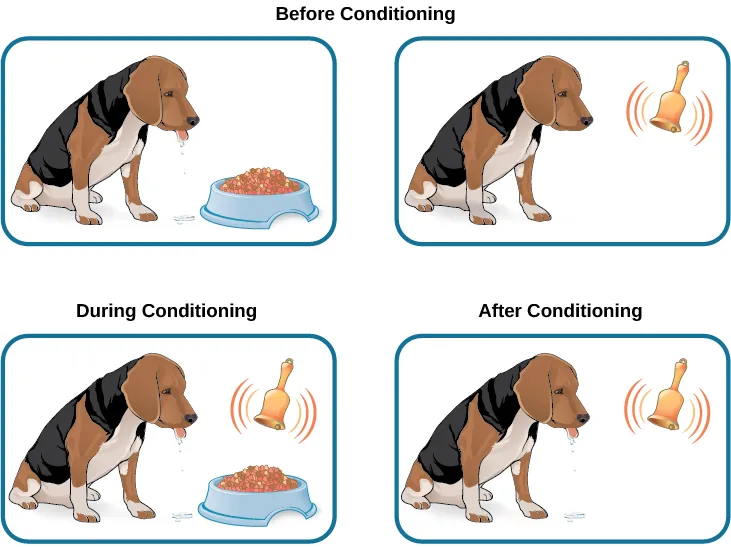
Step-by-step diagram of Pavlovian (classical) conditioning showing how food (UCS) naturally elicits salivation (UCR), while a bell starts as a neutral stimulus (NS) and becomes a conditioned stimulus (CS) after repeated pairings, producing salivation as a conditioned response (CR). This visual supports the logic of acquisition by making the stimulus–response links explicit. Source
Unconditioned stimulus (UCS): naturally produces a response
Unconditioned response (UCR): automatic response to the UCS
Neutral stimulus (NS): initially does not produce the target response
Conditioned stimulus (CS): previously neutral stimulus that now triggers the learned response
Conditioned response (CR): learned response to the CS
The process usually begins with a natural reflex. After repeated pairings, the neutral stimulus gains meaning and starts to produce the response on its own. This learning phase is called acquisition.
Several related processes are important:
Extinction: the conditioned response weakens when the conditioned stimulus is repeatedly presented without the unconditioned stimulus
Spontaneous recovery: an extinguished response may reappear after a rest period
Generalization: similar stimuli produce a similar conditioned response
Discrimination: the learner responds only to a specific conditioned stimulus
Classical conditioning is especially useful for explaining emotional learning. Fear, anxiety, and some preferences or aversions may develop when neutral objects or situations become associated with pleasant or unpleasant experiences. This helps explain how automatic reactions can be learned without conscious intention.
Operant conditioning
While classical conditioning focuses on associations between stimuli, operant conditioning explains learning through the consequences of behavior. Skinner argued that behavior is more likely to be repeated if it is followed by a desirable outcome and less likely to be repeated if it leads to an unpleasant outcome.
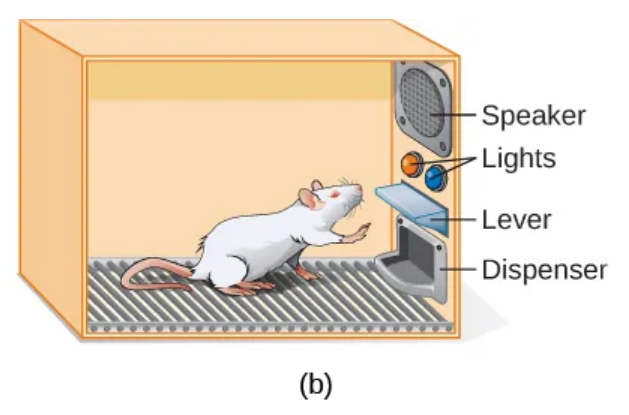
Diagram of a Skinner box (operant conditioning chamber) showing how an animal’s voluntary action (e.g., lever pressing) can be followed by consequences such as food delivery. The labeled parts emphasize experimental control: cues (lights/sounds), the response mechanism (lever), and the reinforcer delivery system (food dispenser). Source
Operant conditioning: A type of learning in which behavior is shaped and maintained by its consequences, especially reinforcement and punishment.
In operant conditioning, behavior is not just triggered by a stimulus. Instead, the organism emits a behavior, and the consequence affects whether that behavior will happen again.
A central concept is reinforcement.
Reinforcement: Any consequence that increases the likelihood that a behavior will be repeated.
Reinforcement can work in two main ways:
Positive reinforcement: adding something pleasant after a behavior, such as praise or a reward
Negative reinforcement: removing something unpleasant after a behavior, such as stopping an irritating noise when the correct response is made
Both forms of reinforcement strengthen behavior. Negative reinforcement is often confused with punishment, but they are not the same. Negative reinforcement increases behavior because an aversive condition is removed.
Another major consequence is punishment.
Punishment: Any consequence that decreases the likelihood that a behavior will be repeated.
Punishment also has two main forms:
Positive punishment: adding something unpleasant after a behavior
Negative punishment: removing something desirable after a behavior
Operant conditioning also includes shaping, where complex behavior is learned gradually by reinforcing small steps toward the desired response. This helps explain how people and animals can learn behaviors that would be unlikely to appear all at once.
The timing and consistency of consequences matter. Behavior is usually learned faster when reinforcement is immediate and clearly connected to the response. If reinforcement is inconsistent, behavior may be learned more slowly, though it can sometimes become more resistant to extinction.
Comparing classical and operant conditioning
The two forms of conditioning both explain learned behavior, but they focus on different processes.
Key differences
Classical conditioning links one stimulus to another stimulus
Operant conditioning links a behavior to a consequence
Classical conditioning often involves automatic or reflexive responses
Operant conditioning usually involves voluntary behavior
Why conditioning matters in psychology
Conditioning helps explain:
how habits form
how fears and emotional reactions can be learned
how rewards can increase desired behavior
how punishment may reduce behavior, at least temporarily
Behaviorism has been influential because it is based on observable evidence and controlled research. However, conditioning does not explain all behavior equally well. Human behavior is often more complex than simple stimulus-response patterns, and learning may also involve expectations, interpretation, and biological predispositions. Even so, classical and operant conditioning remain foundational explanations for how behavior can be acquired and changed.
Practice Questions
Question 1 (2 marks) Define negative reinforcement.
1 mark for stating that it increases or strengthens behavior.
1 mark for stating that this happens through the removal of an unpleasant or aversive stimulus.
Question 2 (6 marks) Explain one difference between classical conditioning and operant conditioning.
1 mark for identifying classical conditioning as learning through association between stimuli.
1 mark for identifying operant conditioning as learning through consequences of behavior.
1 mark for clearly stating one valid difference, such as stimulus-stimulus learning versus behavior-consequence learning.
1 mark for explaining that classical conditioning commonly involves automatic or reflexive responses.
1 mark for explaining that operant conditioning usually involves voluntary behavior.
1 mark for using a relevant example that accurately supports the explanation.
FAQ
Punishment can suppress behavior briefly without teaching a better alternative.
It is less effective when:
it is delayed
it is inconsistent
reinforcement for the behavior still exists
the person does not understand why they were punished
Punishment may also create fear, avoidance, or resentment rather than lasting learning. Behavior often changes more effectively when punishment is paired with reinforcement of a desirable replacement behavior.
Counterconditioning means replacing an unwanted conditioned response with a new, competing response.
For example, a fear response may be replaced with relaxation or calm feelings through repeated new pairings.
Extinction is different because it weakens the learned response by presenting the conditioned stimulus without the original unconditioned stimulus. Counterconditioning does not simply weaken the old response; it builds a new association.
A reinforcement schedule is the pattern that determines when reinforcement is given.
Different schedules influence:
how quickly behavior is learned
how often it is repeated
how resistant it is to extinction
Continuous reinforcement usually produces fast learning but faster extinction. Partial reinforcement often produces slower learning but greater persistence. This is important in understanding why some habits are hard to break.
Taste aversion is a learned dislike of a food after it has been associated with nausea or illness.
It is important because it shows that classical conditioning does not always require many pairings or short time gaps between stimulus and response. In some cases, one strong experience can create a powerful learned response.
This suggests that some associations are learned especially easily, which challenges a very simple view of conditioning.
Yes. Conditioning can occur even when a person is not fully aware that learning is taking place.
In classical conditioning, people may develop emotional responses to objects or situations without clearly remembering how the association formed.
In operant conditioning, habits can become automatic because behaviors have been repeatedly rewarded in the past. Awareness can help people change behavior, but learning itself does not always require deliberate insight.