IB Syllabus focus: 'Schema theory explains how mental frameworks organize and interpret information, shaping perceptions and memories.'
Schema theory is a core idea in cognitive psychology because it shows how prior knowledge helps people understand new experiences quickly, but can also produce distorted perception and inaccurate memory.
What Is a Schema?
A schema is an organized mental structure built from experience. Rather than storing every detail separately, people group knowledge into patterns that help them recognize objects, situations, and relationships. This makes everyday thinking more efficient because new information can be processed in relation to what is already known.
Schema: A mental framework of organized knowledge and expectations that guides the processing, interpretation, and recall of information.
Schemas can concern many areas of life, including objects, roles, places, and events. For example, a student may have a classroom schema that includes desks, a teacher, instructions, and note-taking. When entering an unfamiliar classroom, that schema helps the student predict what is likely to happen even before anything is said.
How Schemas Guide Cognition
Formation and Change
Schemas develop through repeated experience. As people encounter similar situations, they build generalized patterns from them. New information may be assimilated, meaning it is fitted into an existing schema, or accommodated, meaning the schema itself is changed to match new evidence.
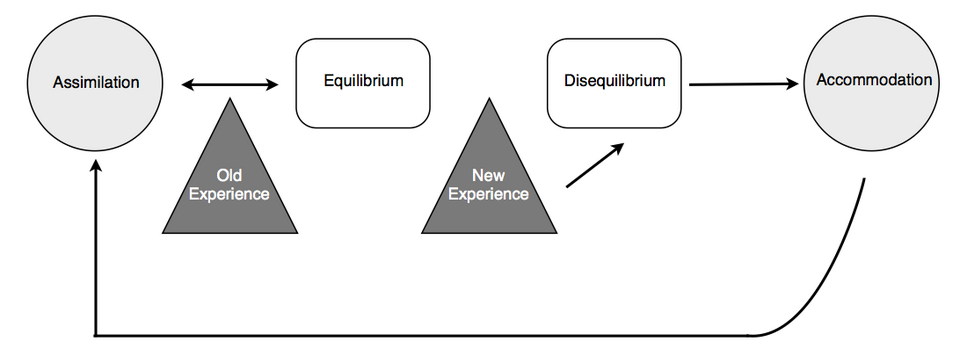
Flowchart of Piagetian adaptation showing how new experiences can be handled through assimilation (fitting information into existing schemas) or accommodation (modifying schemas), often driven by cognitive conflict and the search for equilibrium. This diagram supports the idea that schemas are dynamic structures that update when predictions fail. Source
This makes schema theory dynamic rather than fixed.
Because schemas are based on past experience, they are usually helpful. They reduce the amount of effort needed to process information and allow quick judgments in familiar settings. However, efficiency comes with a cost: once a schema is activated, people may rely on expectation rather than on careful analysis of the immediate situation.
Schemas and Perception
Schema theory argues that perception is not purely a direct recording of the world. Instead, perception is partly top-down, meaning that what a person already knows influences what they notice and how they interpret it. Ambiguous information is especially likely to be shaped by schemas because there is room for expectation to fill in meaning.
Schemas guide attention by making expected details easier to notice. At the same time, unexpected details may be ignored, misunderstood, or judged as less important. This helps explain why two people can observe the same event but leave with different impressions. Their prior knowledge led them to organize the incoming information differently.
Schemas and Memory
Schemas are also central to understanding memory. According to schema theory, remembering is not like replaying a video. Memory is reconstructive, meaning that people actively rebuild the past using stored fragments of information plus existing knowledge.
As a result, recall often preserves the general meaning of an experience better than its exact details.
When information matches an existing schema, it may be easier to encode and later retrieve because it fits into an organized structure. However, schema-consistent information can also lead to distortion. People may remember details that were never present simply because those details would normally fit the situation. They may also alter unusual information so it becomes more familiar and coherent.
This is important for understanding eyewitness recall, reading comprehension, and everyday remembering. A person may be confident in a memory because it feels organized and sensible, even if some parts were supplied by expectation rather than actual experience.
Research Support
Research in cognitive psychology provides strong support for schema theory. Bartlett (1932) asked English participants to recall the Native American story War of the Ghosts. Over repeated reproductions, participants shortened the story, changed unfamiliar elements, and made it more consistent with Western expectations. This suggested that memory is reconstructed through existing cultural schemas.
Brewer and Treyens (1981) also showed how schemas shape recall. Participants briefly waited in an office and were later asked what they remembered. They tended to recall objects that fit an office schema, and some even remembered expected items that were not really there. This supports the idea that schemas influence both perception and memory.
Anderson and Pichert (1978) found that recall changed when participants adopted a different perspective while remembering a story about a house. A new perspective activated a different schema, allowing previously less relevant details to be remembered. This suggests that schemas do not only affect encoding; they also shape retrieval.
Evaluating Schema Theory
Strengths
Schema theory is useful because it explains several cognitive processes with one idea: prior knowledge helps organize perception, comprehension, and memory. It also matches everyday experience, since people often interpret new events by comparing them with what they already know.
Another strength is empirical support. Studies repeatedly show false recall, selective attention, and changes in remembering based on expectations or perspective. These findings make schema theory valuable for explaining why memory is efficient but sometimes inaccurate.
Limitations
A common criticism is that the concept of a schema can be broad and difficult to define precisely. Psychologists often infer schemas from behavior rather than observe them directly, which can make measurement less exact. Different researchers may also use the term in slightly different ways.
Schema theory can also be criticized for being descriptive. It explains that prior knowledge affects cognition, but it is sometimes less specific about exactly how schemas are represented in the mind or when they will dominate over immediate evidence. As a result, the theory is strong at explaining patterns of cognition, but weaker at giving a complete account of all mental processing.
Practice Questions
State one characteristic of memory according to schema theory.
1 mark for stating that memory is reconstructive or influenced by prior knowledge.
1 mark for a brief explanation that schemas guide recall and can distort remembered details.
Explain how schema theory helps explain inaccurate memory. Refer to one study in your answer.
1 mark for defining a schema as an organized mental framework based on prior knowledge.
1 mark for explaining that memory is reconstructive rather than an exact copy of events.
1 mark for explaining one way inaccuracy occurs, such as filling gaps with expected details or changing unfamiliar material.
1 mark for accurately describing one relevant study.
1 mark for clearly linking the findings of the study to schema-based memory distortion.
1 mark for using accurate psychological terminology in a coherent explanation.
FAQ
Usually not. Many schemas operate automatically, especially in familiar situations. People often notice their influence only after making a quick judgment or a memory error.
Schemas become easier to notice when:
expectations are violated
a situation is unfamiliar
a person is asked to explain their thinking
Psychologists usually infer schemas from behavior on cognitive tasks. They compare what people actually experienced with what they later recall, recognize, or expect.
Common methods include:
false recall tasks
perspective-shift experiments
reaction time measures
expectancy-violation designs
Experts usually have richer and better-organized schemas in their area of knowledge. This lets them group details into meaningful patterns instead of treating each detail as separate.
The advantage is mostly domain-specific. For example, an expert may remember meaningful material in their field very well, but not random information that does not match an existing schema.
Yes. Schemas are stable because repeated experience reinforces them, but they are not fixed for life. Education, travel, therapy, new social roles, and major life events can all challenge old expectations.
Change is more likely when:
new evidence appears repeatedly
the old schema stops working well
the person reflects on contradictions rather than ignoring them
A memory often feels convincing when it is coherent, detailed, and easy to retrieve. Schemas help create that sense of order, so a reconstructed memory can feel very real.
Confidence does not guarantee accuracy. A memory may seem trustworthy because it fits expectations well, even if some of its details were added later rather than actually experienced.