IB Syllabus focus: 'Cognitive theories explain human development, health problems, prevention and learning in applied psychology.'
Applications of cognitive theories show why the cognitive approach matters beyond the classroom: ideas about attention, memory, beliefs, and interpretation are used to improve development, health, prevention, and learning in real settings.
What application means
In applied psychology, cognitive theories are used to solve practical problems rather than only describe mental processes. Psychologists use cognitive principles to predict how people will respond in schools, clinics, and community programs. They then design interventions based on how individuals attend to information, interpret events, store memories, and use mental strategies. This makes the cognitive approach especially useful when the goal is to improve performance, wellbeing, or adjustment.
Applied psychology: The use of psychological theories and research to understand and improve real-world behavior, wellbeing, and performance.
A key idea is that behavior can often be changed by changing patterns of thinking. Cognitive applications therefore focus on both explanation and intervention.
Cognitive theories and human development
Cognitive theories are applied to human development by examining how thinking changes across childhood, adolescence, and adulthood. Instead of treating development as only physical growth, psychologists study changes in attention, memory strategies, reasoning, perspective taking, and self-regulation. This helps explain why children may misunderstand instructions, why adolescents become better at abstract thinking, and why adults may use more experience-based judgments.
These ideas have practical value because they help professionals match tasks to a person’s developmental level. Development is not just about what someone knows; it is also about how they process information. Applied cognitive work can therefore support early identification of developmental difficulties by showing where a breakdown may occur in understanding, remembering, or problem-solving.
Practical implications
learning materials can be matched to developmental level
adults can give instructions in ways that are easier to understand and remember
interventions can teach planning, rehearsal, and organization strategies
support can focus on self-monitoring and impulse control, not only academic outcomes
Cognitive theories and health problems
In health psychology, cognitive theories explain how beliefs, appraisals, and expectations influence mental and physical health. The same event may produce very different reactions depending on how it is interpreted. If a person expects failure, overestimates threat, or focuses attention on negative information, distress may increase. These patterns are relevant to anxiety, depression, chronic pain, and illness behavior.
Cognitive processes also affect whether people seek help, follow treatment instructions, and remain committed to recovery. For example, if someone believes treatment will not work, adherence may fall. If symptoms are interpreted in highly catastrophic ways, fear and avoidance may increase.
A major application is cognitive-behavioral therapy (CBT). Although CBT includes behavioral methods, its cognitive element is central: it helps people identify unhelpful thoughts, evaluate them against evidence, and develop more balanced interpretations.
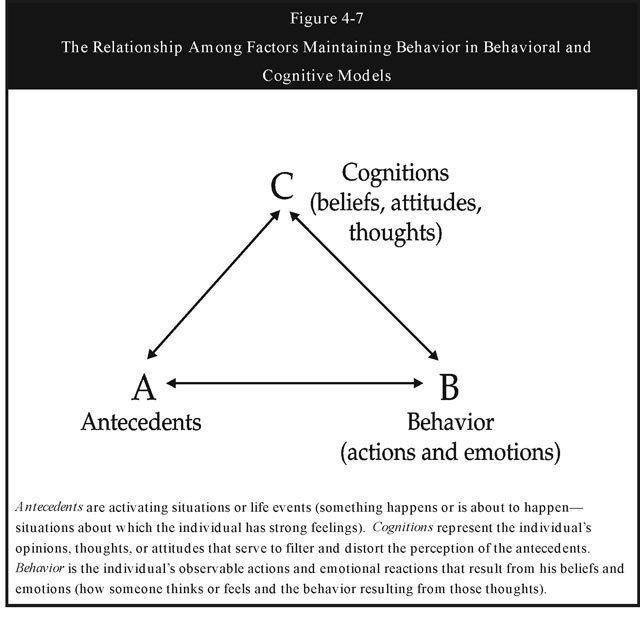
This diagram depicts the cognitive model’s central claim that cognitions (thoughts), affect (feelings), and behavior mutually influence one another. It provides a visual rationale for CBT interventions: changing appraisals and automatic thoughts can shift emotional responses and downstream behavior. Source
Cognitive ideas are also used in pain management, where expectations and attention can influence how symptoms are experienced. The practical importance of cognitive theory here is that changing thought patterns can improve functioning, not just insight.
Cognitive theories and prevention
Prevention uses cognitive principles before serious problems appear or become more severe. Rather than waiting until a disorder or harmful behavior is established, psychologists aim to reduce risk by changing the thinking processes linked to that risk.
Prevention: Actions designed to reduce the likelihood, severity, or recurrence of psychological or health problems.
Cognitive prevention programs may teach people to recognize distorted thoughts, improve problem-solving, strengthen self-control, and build realistic beliefs about coping. In schools, prevention often focuses on emotional understanding, thinking skills, and resilience. In health settings, prevention campaigns work best when messages are simple, memorable, and personally relevant, because attention and memory shape whether information is understood and retained.
This shows an important applied principle: prevention is more effective when people do not just receive information, but process it in a meaningful way.
Cognitive theories and learning
Learning is one of the clearest applications of cognitive theory. Cognitive explanations treat learners as active processors of information, not passive recipients. Effective teaching supports encoding, organization, retrieval, and metacognition.
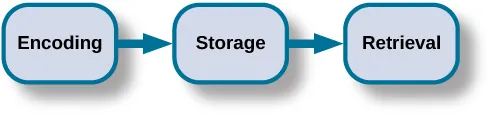
This figure summarizes memory as an information-processing sequence: encoding (getting information in), storage (retaining it over time), and retrieval (bringing it back into awareness). It helps link classroom strategies (e.g., spacing and retrieval practice) to the specific cognitive processes they are designed to strengthen. Source
Students usually learn more when new material connects to prior knowledge, is organized clearly, and is practiced over time rather than only once.
Cognitive applications to learning also recognize that attention is limited. If lessons contain too much irrelevant information, learners may struggle to identify what matters. If information is presented in manageable steps, understanding and retention improve. This is why cognitive ideas are widely used in education, training, and instructional design.
Educational implications
lessons should be structured so key ideas stand out
practice should include retrieval, not only rereading
feedback should help learners monitor mistakes and choose better strategies
complex skills should be taught step by step so mental demands stay manageable
students benefit from reflecting on how they learn, not just what they learn
Strengths and limitations in applied settings
A major strength of applying cognitive theories is that they produce practical interventions. They turn abstract ideas about mental processing into therapies, teaching methods, and prevention programs. They are also useful across many settings, including schools, clinics, and public health.
However, cognitive applications can be limited if they focus too narrowly on internal thought processes. Real-world outcomes are also affected by context, relationships, stress, and access to support. In addition, thoughts are often inferred from self-report or performance rather than observed directly. For IB Psychology, the key issue is that cognitive theories are highly valuable in applied psychology because they guide real interventions, but they must be used with awareness of the wider situation.
Practice Questions
State one way cognitive theories are applied to learning in applied psychology. [2]
1 mark for identifying a relevant application to learning, such as improving memory, attention, or study strategies.
1 mark for briefly linking that application to a cognitive process, such as retrieval, organization, or metacognition.
Explain one application of cognitive theories to health problems in applied psychology. [6]
1-2 marks for identifying a relevant cognitive concept, such as beliefs, appraisals, expectations, or interpretation of symptoms.
1-2 marks for explaining how this concept affects a health problem, such as anxiety, depression, chronic pain, or treatment adherence.
1-2 marks for developing the answer with an applied use, such as CBT, pain management, or improving adherence through changing maladaptive thinking.
FAQ
Basic cognitive research mainly asks how mental processes work under controlled conditions, such as how memory or attention operates.
Applied cognitive psychology uses that knowledge to improve outcomes in real settings. For example, it may be used to:
redesign lessons
reduce unhelpful thinking in therapy
improve health communication
The trade-off is that applied work often deals with messier, less controlled environments.
Cognitive theories fit digital tools well because apps can deliver short, repeated activities that target specific mental processes.
Examples include:
reminders that support spaced practice
thought records that track negative interpretations
prompts that encourage self-monitoring
quizzes that strengthen retrieval
Their success depends on user engagement. A strong cognitive design can still fail if the app is confusing, boring, or not personalized enough.
They usually compare performance or wellbeing before and after the intervention, and sometimes against a control group.
Common indicators include:
symptom reduction
better recall or academic performance
improved coping skills
stronger treatment adherence
lasting change at follow-up
Researchers also check whether change transfers to daily life, not just to a test or clinic session.
Yes. Some interventions assume that people think about the self, health, or success in the same way across cultures.
Bias can appear in:
the language used in materials
examples that feel unfamiliar
assumptions about independence or personal control
ideas about what counts as a “rational” response
Applied psychologists reduce bias by adapting wording, goals, and delivery to fit the cultural context of the target group.
Transfer means using knowledge or skills learned in one situation in a different situation.
It is difficult because students may memorize procedures without understanding when or why to use them. Transfer improves when instruction includes:
varied practice
comparison of similar problems
explanation of underlying principles
reflection on strategy choice
This matters in applied psychology because real learning is valuable only if it can be used beyond the original lesson or task.