IB Syllabus focus: 'Cognitive load theory helps explain human cognition and the demands placed on mental processing.'
Cognitive load theory explains why some tasks feel mentally easy while others overwhelm attention. It links learning and thinking to the limited capacity of working memory.
Core idea of cognitive load theory
Cognitive load theory focuses on how much mental effort a task requires at a given moment. It is especially useful for explaining learning, attention, and problem solving because these activities depend on a limited processing system.
Cognitive load theory: A theory proposing that thinking and learning are constrained by the limited capacity of working memory, so performance depends on how much mental effort a task requires.
A central claim is that working memory can only handle a limited amount of new information at one time, whereas long-term memory can store far more organized knowledge.
When task demands exceed working-memory capacity, performance often becomes slower, less accurate, or more superficial.
Working memory: The mental system used to hold and process information temporarily during tasks such as reasoning, comprehension, and learning.
This helps explain why people may understand simple information immediately but struggle when many unfamiliar elements must be processed at once. Cognitive load theory therefore treats mental processing as limited, dynamic, and strongly affected by task design.
Types of cognitive load
Psychologists commonly describe three forms of load.
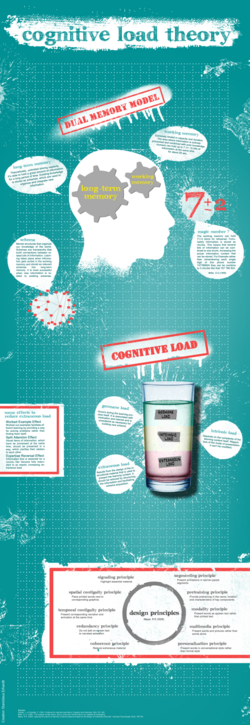
This infographic provides a visual overview of cognitive load theory by separating cognitive demands into intrinsic, extraneous, and germane load. It is useful for quickly linking each load type to its source (task complexity vs. presentation vs. schema-building effort) and to the overall goal of managing working-memory limits during learning. Source
Intrinsic cognitive load
Intrinsic load comes from the task itself. Some material contains many parts that must be understood together, so it naturally places higher demands on mental processing. A task usually feels more complex when:
it contains many interacting elements
the learner has little prior knowledge
accurate understanding depends on holding several ideas in mind at once
Intrinsic load cannot always be removed, because some content is genuinely complex. However, it can often be managed by sequencing information carefully and building understanding step by step.
Extraneous cognitive load
Extraneous load is caused by the way information is presented rather than by the content itself. Poor instructions, distracting visuals, unnecessary repetition, or confusing layouts consume mental resources that could otherwise support understanding.
Examples of sources of extraneous load include:
irrelevant details that split attention
explanations that are overly wordy or disorganized
tasks that require learners to search for essential information
presentation formats that make the learner coordinate disconnected sources
Extraneous load is especially important because it is often avoidable. Reducing it helps preserve limited cognitive capacity for the central task.
Germane cognitive load
Many descriptions of cognitive load theory also include germane load, meaning mental effort directed toward forming useful understanding. This is the effort invested in organizing information, recognizing meaningful patterns, and connecting new material to existing knowledge.
In practice, germane processing becomes more likely when intrinsic load is manageable and extraneous load is low. That is why efficient instruction does not simply make thinking easier; it frees resources for deeper processing.
Why cognitive load theory matters for cognition
Cognitive load theory helps explain several features of human cognition. First, it shows why attention is selective: people cannot process all incoming information equally well when mental resources are limited. Second, it explains why problem solving often breaks down when too many novel steps must be considered at once.
The theory also explains differences between novices and more experienced learners. Prior knowledge stored in long-term memory can reduce current mental demands because familiar information is processed in larger, more efficient units. As knowledge becomes well organized, less conscious effort is needed for tasks that were once demanding.
This is also connected to automaticity, where repeated practice allows some processes to occur with much less working-memory demand. Skilled readers, drivers, or musicians often perform basic components of a task with relatively little conscious effort, leaving more capacity available for higher-level decisions.
From this perspective, errors are not always signs of low ability. They may reflect overload, poor presentation, or a mismatch between task demands and available mental resources.
Applying cognitive load theory to learning tasks
Cognitive load theory is widely used to think about how tasks can be structured so that cognition is supported rather than overloaded. The aim is not to remove all difficulty, but to ensure that mental effort is spent on relevant processing.
Useful strategies include:
breaking complex material into smaller stages
presenting essential information clearly and in a coordinated format
removing decorative but irrelevant content
giving guidance early in learning, then reducing support as understanding grows
allowing practice so that basic components become more automatic
These ideas help explain why the same task can feel very different depending on context. A confusing environment can increase mental load even when the content is not especially difficult, while a well-designed task can make complex thinking more manageable. Cognitive load theory therefore offers psychologists a way to explain both the limits of human cognition and the conditions under which mental processing is most effective.
Practice Questions
State one reason why extraneous cognitive load can reduce performance.
1 mark for identifying that extraneous load comes from the way information is presented rather than from the task itself.
1 mark for explaining that it uses limited working-memory resources, reducing attention available for the main task.
Explain how cognitive load theory helps psychologists understand human cognition.
1 mark for defining cognitive load theory as the idea that thinking and learning are limited by working-memory capacity.
1 mark for explaining intrinsic load as load caused by the inherent complexity of the task.
1 mark for explaining extraneous load as load caused by poor presentation or unnecessary information.
1 mark for explaining that overload can reduce attention, learning, reasoning, or problem-solving accuracy.
1 mark for explaining that prior knowledge or long-term memory can reduce current mental demands.
1 mark for applying the theory to a cognitive process such as learning, attention, or task performance.
FAQ
Researchers usually estimate cognitive load indirectly rather than observing it directly.
Common methods include:
self-report mental effort scales
reaction time measures
dual-task methods, where performance drops on a second task if load is high
eye-tracking or pupil dilation
error rates and task completion time
Using several measures together is often better than relying on one method, because each method captures a different part of mental demand.
The expertise reversal effect means that instructional support helpful for beginners may become unhelpful for advanced learners.
For example:
novices often benefit from detailed guidance
experienced learners may find the same guidance repetitive or distracting
From a cognitive load perspective, material that reduces load for beginners can create unnecessary extraneous load for experts. This is why effective instruction should match the learner’s level of knowledge.
Multitasking is difficult because multiple tasks compete for limited working-memory and attentional resources.
When people switch between tasks, they often must:
reorient attention
remember different goals
reload relevant information into working memory
This increases mental demand and can produce slower responses, more mistakes, and weaker learning. People may feel productive while multitasking, but cognitive load theory predicts that performance often suffers when tasks rely on the same limited mental resources.
Yes. Cognitive load theory is useful anywhere people must process information under limited mental capacity.
Examples include:
dashboard and cockpit design
medical instructions
workplace training
website and app interfaces
emergency procedures
In these settings, poor design can overload users and increase mistakes. Clear organization, reduced distraction, and well-sequenced information can improve accuracy and decision-making, especially when tasks are unfamiliar or stressful.
Cognitive load is not the same as intelligence. It refers to the immediate mental demand created by a task in a specific situation.
A highly intelligent person can still perform poorly if:
the instructions are confusing
too much new information is presented at once
attention is divided
Motivation also differs from load. A motivated learner may try harder, but effort cannot fully overcome severe working-memory overload. Cognitive load theory therefore focuses on task demands and information design, not just personal ability or willingness.