IB Syllabus focus: 'Dual processing theory explains conscious and unconscious information processing in thinking and decision-making.'
Dual processing theory helps explain why people sometimes rely on rapid intuition and at other times on careful reasoning. It is especially useful for understanding judgment, reasoning, and choices in everyday and high-stakes situations.
What is dual processing theory?
Dual processing theory proposes that human thinking operates through two broad modes of processing. One mode is fast, automatic, and often outside conscious awareness. The other is slower, effortful, and more deliberate. These are commonly described as System 1 and System 2.
Dual processing theory: A theory of cognition proposing that thinking involves two broad types of processing: one that is fast and automatic, and another that is slow and controlled.
The theory does not suggest that people literally have two separate minds. Instead, it describes two different styles of processing that work together. In many situations, an immediate impression appears first, and then more deliberate thinking may evaluate or correct it. This helps explain both efficient everyday thinking and common errors in judgment.
System 1
System 1 is the fast, intuitive mode of thinking. It operates with little conscious effort and is often linked to unconscious processing, meaning that a person may not be fully aware of the steps involved in reaching a judgment. It depends heavily on associations, habits, and previous experience.
Common features of System 1 include:
rapid responses
little mental effort
automatic processing
intuitive judgments
sensitivity to emotion and context
When a person instantly recognizes a familiar face or reacts quickly to a common situation, System 1 is usually involved.
A common feature of System 1 is the use of mental shortcuts.
Heuristic: A simple mental shortcut used to make judgments or decisions quickly.
Heuristics are efficient, but because they simplify information, they can also increase the chance of error.
System 2
System 2 is slower and more deliberate. It is more closely related to conscious processing, because it requires attention, reflection, and active control. System 2 is especially important when a task is unfamiliar, complex, or demands logical analysis.
Common features of System 2 include:
slower processing
greater mental effort
deliberate attention
rule-based reasoning
evaluation of evidence
Tasks such as checking an argument carefully, comparing alternatives, or solving a difficult problem depend more on System 2.
Conscious and unconscious processing
In dual processing theory, unconscious processing does not mean mysterious thinking. It usually means processing that happens without deliberate awareness. A person may know the answer or feel a strong impression, but may not be able to explain how that response was produced.
By contrast, conscious processing involves awareness of the steps being taken. A person can usually describe why they chose an answer, rejected an option, or changed their mind. This distinction is central to the theory because it explains why some judgments feel immediate while others feel effortful.
How the two systems interact
The two systems should not be seen as completely separate or always in conflict. More often, System 1 produces an initial response, and System 2 monitors that response when needed. In many everyday situations, this is efficient. If every decision required full analysis, thinking would become too slow and demanding.
However, System 2 does not always intervene. If a person is distracted, tired, rushed, or not motivated to think deeply, they may accept the first answer provided by System 1. As a result, decisions may be quick but not always accurate.
This interaction shows that dual processing theory is not only about speed. It is about the relationship between automatic intuition and deliberate reasoning in cognition.
Dual processing theory in decision-making
Dual processing theory is especially important for understanding decision-making.
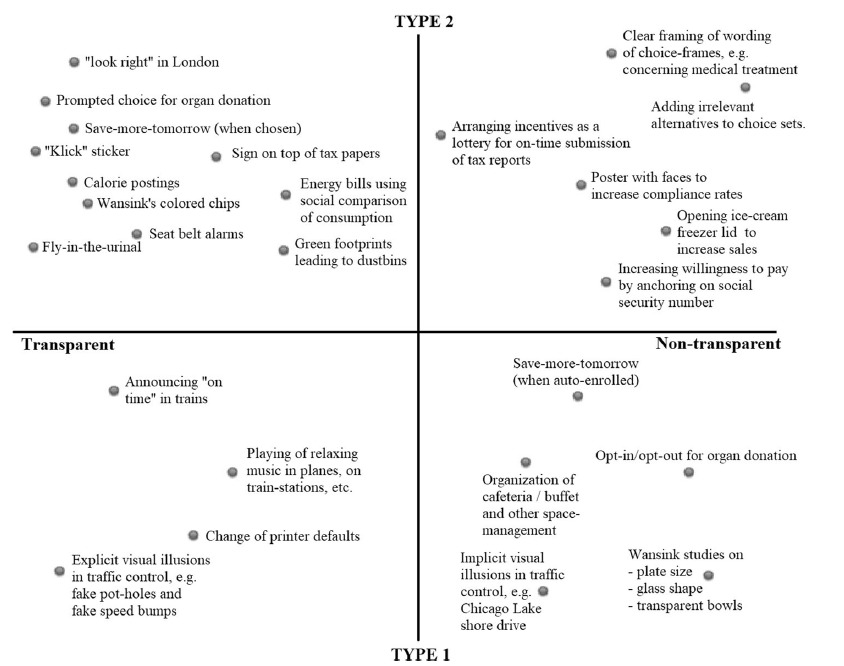
This matrix distinguishes interventions that primarily target automatic, System 1–like responses from those that engage reflective, System 2–like reasoning. By organizing examples into categories, it makes the interaction between intuitive and deliberate processing more concrete in applied decision-making contexts. Source
In familiar or urgent situations, System 1 can be highly adaptive. It saves time and may lead to good judgments when based on relevant experience. This is one reason why people can often function efficiently in daily life without analyzing every small choice.
In more complex situations, however, fast thinking may be less reliable. Decisions involving several options, long-term consequences, or conflicting evidence usually require System 2. Deliberate reasoning helps people:
compare alternatives carefully
question first impressions
assess evidence more critically
resist impulsive responses
justify choices logically
A key point is that people do not always shift into analytical thinking automatically. Because System 2 requires effort, people often stay with the easier intuitive response unless something signals that deeper thinking is necessary.
Strengths and limitations
One strength of dual processing theory is that it offers a clear and practical framework for understanding both conscious and unconscious cognition. It helps explain why people can think quickly and effectively in many situations, while also showing why reasoning errors may occur.
At the same time, the model can be oversimplified. Human thinking does not always fit neatly into two separate categories. Some tasks involve both automatic and controlled elements, and people may move gradually between them rather than switching completely.
Another limitation is that System 1 and System 2 are theoretical constructs, not exact physical locations in the brain. The theory is therefore useful as a model of cognition, but it does not fully capture every aspect of human thought. Practice can also change processing style, so a task that begins as slow and conscious may later become fast and automatic.
Practice Questions
State two characteristics of System 1 processing in dual processing theory. [2]
1 mark for each correct characteristic, up to 2 marks.
Accept any two of:
fast
automatic
intuitive
low effort
often outside conscious awareness
based on associations or heuristics
Explain dual processing theory with reference to thinking and decision-making. [6]
1 mark for identifying that the theory proposes two broad modes of processing.
1 mark for describing System 1 as fast, automatic, intuitive, or often unconscious.
1 mark for describing System 2 as slow, controlled, effortful, or conscious.
1 mark for explaining that System 1 often generates an initial response and System 2 may monitor or override it.
1 mark for applying the theory to decision-making, such as routine decisions relying more on System 1 or complex decisions requiring System 2.
1 mark for a developed explanation showing how differences in processing affect the quality or speed of decisions.
FAQ
Not in a simple one-to-one way.
Dual processing theory is mainly a cognitive model, so System 1 and System 2 describe patterns of thinking rather than fixed brain locations.
Some brain networks are more involved in automatic responding, while others are more involved in control and monitoring. However, psychologists generally do not treat the two systems as neatly separated anatomical units.
Expert intuition is often built through repeated experience.
Over time, people learn patterns that allow rapid recognition of important cues. As a result, what looks like an instant judgment may actually reflect years of learning.
This means fast thinking is not always careless. In the right context, it can be highly accurate because experience has improved the quality of automatic responses.
Stress and time pressure usually make people rely more on System 1.
This happens because:
attention becomes narrower
there is less time for checking
mental resources are reduced
In urgent situations, this can be useful because fast action may be necessary. But in tasks that require careful comparison or logical reasoning, heavy reliance on System 1 can increase mistakes.
Yes. Different psychologists have proposed related models using different labels.
Examples include:
heuristic vs. analytic
automatic vs. controlled
intuitive vs. reflective
These models are not identical, but they share the same core idea: human cognition often involves one faster, less effortful mode and one slower, more deliberate mode.
A useful strategy is to notice when an answer feels immediate and then ask whether the task actually needs deeper checking.
System 2 is especially useful when:
a question is unfamiliar
several options seem plausible
evidence must be compared
emotions may be influencing judgment
Simple habits can help trigger slower thinking, such as pausing, rereading the question, and explaining your reasoning in words.