IB Syllabus focus: 'Cross-cultural psychology uses etic approaches to compare how different cultures shape behaviour.'
Psychologists use cross-cultural comparisons to test whether findings reflect universal processes or culture-specific experiences. Etic research is central because it applies shared measures across groups to identify meaningful similarities and differences.
What is cross-cultural psychology?
Cross-cultural psychology is the systematic comparison of psychological processes and behavior across cultural groups.
Cross-cultural psychology asks whether a theory, behavior, or mental process appears in similar ways across different societies. It does not assume that one cultural group is the standard for all others. Instead, culture is treated as an important variable that may shape how people think, feel, and act. This makes the approach especially useful for testing how far psychological findings can be generalized beyond the setting in which they were first discovered.
The etic approach
An etic approach studies behavior using concepts, categories, or measures intended to apply across cultures.
An etic approach begins with the idea that some aspects of psychology can be examined through common tools. Researchers may use the same questionnaire, memory task, interview schedule, or observation checklist in two or more cultural groups and then compare patterns in the data. The purpose is not simply to find differences. It is also to identify possible universals, meaning patterns that appear consistently across cultures, and to test whether a theory developed in one place also works in another.
This approach supports a more scientific style of comparison because it emphasizes standardization and replication. Key features often include:
the same research question across groups
the same operationalized variables
similar instructions, timing, and scoring
data that can be compared directly
How etic research is carried out
For an etic comparison to be meaningful, researchers must make sure that the study is comparable across settings, not just copied across settings. Important steps include:
selecting cultures that are relevant to the research question
designing measures that can travel across languages and contexts
using careful translation and back-translation
matching samples as closely as possible on factors such as age, education, or gender
keeping procedures as similar as possible during data collection
Researchers also need to check whether the construct has the same meaning in each group.
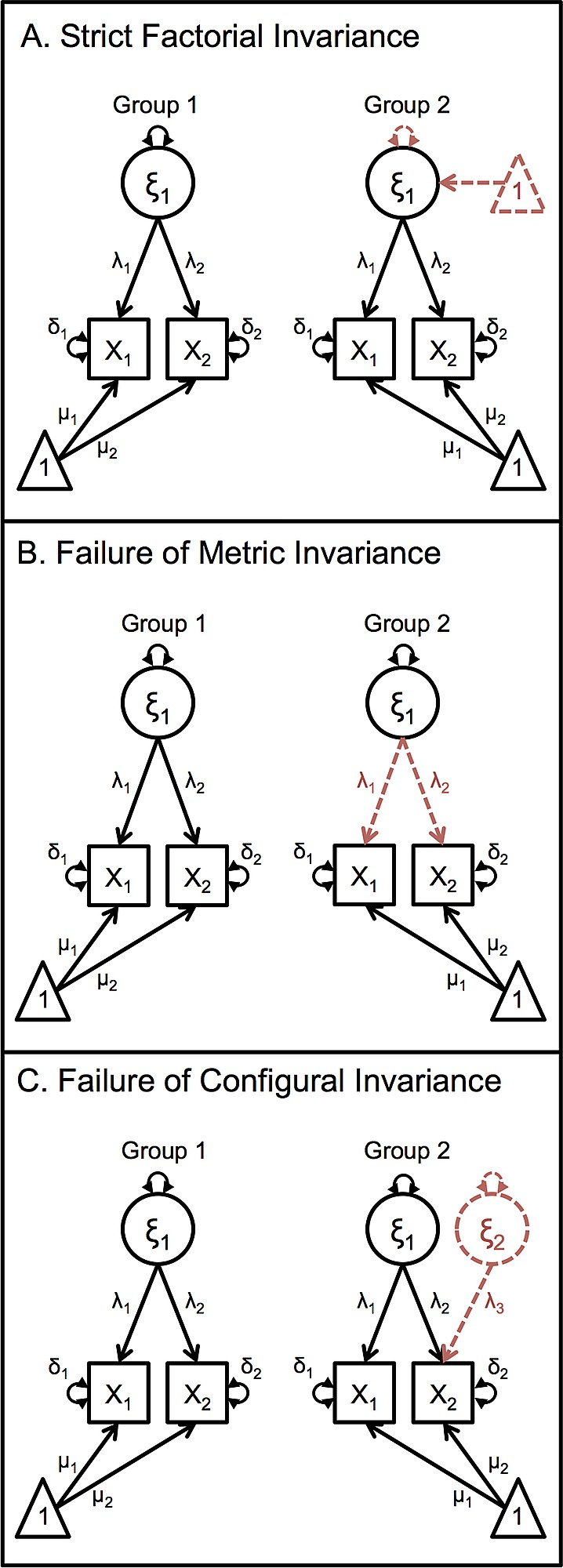
This diagram illustrates common outcomes in measurement invariance testing, showing when a factor model is comparable across groups (and when it is not). It helps explain why cross-cultural group differences can be misleading if the underlying measurement structure differs across cultures. In etic research, establishing invariance is one way to support the claim that a questionnaire is measuring the same psychological construct in each group. Source
A scale that appears to measure self-esteem, trust, or aggression in one society may capture something different in another. If this is not checked, apparent cultural differences may actually be differences in interpretation, familiarity with the testing situation, or response style.
Cross-cultural etic studies can use experiments, surveys, interviews with standardized questions, or structured observations. What makes the research etic is not the method itself, but the use of common categories for comparison.
What etic research can show
Etic research helps psychologists answer two major questions. First, are some psychological processes broadly shared by human beings? Researchers may compare emotional recognition, basic memory patterns, moral judgments, or social behavior across multiple societies. If similar findings emerge in very different cultural settings, this gives cautious support to the claim that a process may be widespread or universal.
Second, how does culture influence behavior? When the same measure produces different results across groups, psychologists can investigate how norms, values, child-rearing practices, education, social roles, or institutions may shape the outcome. In this way, culture is not treated as background information. It becomes part of the explanation for why behavior varies.
Etic research is therefore useful both for testing universality and for identifying the limits of theories that may be too culture-specific.
Strengths of etic research
One major strength is direct comparability. Because researchers use shared measures, results from different cultural groups can be evaluated side by side rather than described in unrelated ways.
Another strength is that etic research can challenge ethnocentrism, the assumption that findings from one culture automatically apply to all people. Cross-cultural comparison may show that a theory travels well, or it may reveal that it reflects the experiences of only a narrow population.
Etic research is also valuable for building broader psychological theories. If a finding is replicated across very different settings, confidence in its general relevance increases. If it changes sharply across cultures, the theory may need revision.
Limitations and evaluation
The biggest challenge is cultural bias. A test designed in one culture may carry assumptions that do not fit another. For example, a questionnaire may treat independence, emotional expression, or eye contact as normal and desirable, even though these meanings vary across societies. In that case, the study may compare groups fairly in form but not in meaning.
A second problem is the risk of imposing categories from one culture onto another. Researchers may believe they are measuring the same thing everywhere when they are actually forcing different experiences into the same box. This can create misleading findings and make one culture's concepts look universal when they are not.
Researchers must also avoid treating cultures as simple, uniform units. National comparisons can hide important differences within a country, including region, social class, religion, generation, migration history, or urban-rural background. As a result, cross-cultural findings should not be used to stereotype entire populations.
Interpretation is another issue. A difference between groups does not automatically mean culture caused the effect. Other influences, such as schooling, technology access, economic conditions, or familiarity with research settings, may also help explain the result. Strong cross-cultural studies either control such factors or discuss them clearly as alternative explanations.
Finally, the standardization that makes etic research powerful can also make it narrow. A highly structured measure may be reliable across groups but still miss culturally important meanings. Because of this, psychologists need to evaluate etic findings carefully and ask whether the comparison captures the same phenomenon in each cultural context.
Practice Questions
(2 marks): State one feature of an etic approach in cross-cultural psychology.
1 mark for identifying that the same concepts, categories, or measures are used across cultures.
1 mark for stating that this allows direct comparison between cultural groups.
(6 marks): Explain one strength and one limitation of using etic approaches in cross-cultural psychology.
1 mark for identifying one relevant strength, such as direct comparability or testing universality.
2 marks for explaining how that strength helps psychologists compare cultures or assess generalizability.
1 mark for identifying one relevant limitation, such as cultural bias or imposed categories.
2 marks for explaining how that limitation can distort findings or lead to misleading conclusions.
FAQ
WEIRD stands for Western, Educated, Industrialized, Rich, and Democratic.
The term matters because many classic psychological findings were built from WEIRD samples, especially university students. If those findings are treated as universal without wider testing, psychologists may mistake a culturally narrow pattern for a human universal.
Cross-cultural research helps correct this problem by testing whether results found in WEIRD populations also appear elsewhere.
Decentering is the process of revising a measure in more than one language at the same time, instead of treating one language version as the perfect original.
This helps researchers:
remove culture-specific wording
simplify unclear items
improve equivalence across versions
It is especially useful in etic research because it aims to build a tool that works across groups, rather than merely translating one culture's assumptions into another language.
The ecological fallacy happens when researchers use group-level data to make claims about individuals.
For example, if a country has a high average score on a cultural indicator, it does not mean every person in that country shows that trait. National averages can hide large individual differences.
This matters because cross-cultural psychology often compares countries or regions, and careless interpretation can turn broad trends into inaccurate claims about people.
Multinational teams can improve research quality because they bring different cultural knowledge into the same project.
They can help by:
spotting hidden assumptions in measures
improving recruitment strategies
identifying awkward or misleading wording
offering more balanced interpretation of findings
This reduces the chance that one cultural perspective dominates the entire study design.
They can be, but reliability depends on design quality.
Strengths include:
access to larger and more diverse samples
standardized presentation of tasks
faster data collection across countries
Limitations include:
unequal internet access
device differences
distractions in testing environments
fraud or low-quality responses
Researchers improve reliability with pilot testing, attention checks, local collaborators, and clear exclusion criteria.