IB Syllabus focus: 'Enculturation explains internalizing cultural norms, while acculturation explains adapting to cultural change.'
Enculturation and acculturation describe two ways culture shapes people across the lifespan: one through learning a familiar culture, the other through adjusting when cultural contexts change through migration, contact, or globalization.
Core ideas
Culture provides shared expectations about behavior, communication, relationships, rituals, and values. Psychologists separate enculturation from acculturation because they describe different kinds of cultural learning and cultural change.
Enculturation begins early and is usually gradual.
Enculturation: The process of learning and internalizing the norms, values, beliefs, and customary behaviors of one’s culture.
Much of enculturation happens so routinely that it feels natural rather than learned. People absorb ideas about politeness, authority, gender expectations, emotional expression, and group obligations through everyday participation in cultural life.
Acculturation refers to adaptation after contact with a different cultural environment.
Acculturation: The process of psychological and behavioral adjustment that occurs when individuals or groups come into continuous contact with a different culture.
Unlike enculturation, acculturation is often more visible and more consciously negotiated. People may compare old and new expectations and decide which practices to retain, modify, combine, or reject.
How enculturation occurs
Enculturation operates through repeated interaction with important social agents.
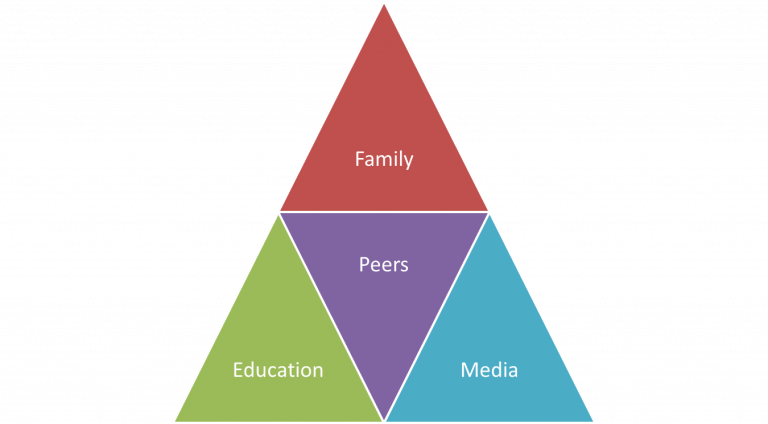
The diagram summarizes how enculturation is transmitted through major agents of socialization—family, peers, education/schools, and media. It supports the idea that cultural learning is not a single event but a cumulative process shaped by multiple everyday contexts. While the example is gender-focused, the same channels help explain how wider cultural norms and values are internalized over development. Source
These commonly include:
Family, which teaches language, manners, beliefs, food practices, and social roles
Peers, who reinforce acceptable clothing, humor, music, and behavior
Schools, which transmit formal rules, national values, and expectations for achievement
Religious institutions, which shape moral beliefs, rituals, and life-cycle practices
Media and digital platforms, which model ideals, stereotypes, and cultural narratives
Learning can be explicit, such as direct instruction, or implicit, such as observation and imitation. Rewards and disapproval also matter. A child who is praised for respectful behavior or corrected for breaking a norm gradually learns what the culture values.
Stories, celebrations, and routines matter too. National holidays, greetings, eating practices, and expectations about eye contact or personal space communicate culture without formal lessons.
Enculturation does not mean every member of a culture becomes identical. People differ in personality, class, region, family background, and life experience. However, enculturation helps explain why members of the same cultural community often share familiar assumptions about what is normal, desirable, or inappropriate.
How acculturation occurs
Acculturation typically begins when there is sustained intercultural contact. Common contexts include migration, refugee resettlement, international schooling, transnational families, intermarriage, or growing up as part of a minority group within a dominant culture.
Acculturation can affect many areas of life:
Language use, such as code-switching or language loss
Identity, including stronger, weaker, or mixed attachment to cultural groups
Social relationships, especially friendships, dating, and family roles
Daily habits, such as food, dress, media use, and leisure activities
Values, including attitudes toward independence, obedience, religion, and success
Psychologists often distinguish behavioral adaptation, such as new language use, from psychological adaptation, such as feeling competent, accepted, and emotionally secure in the new setting.
A widely used way to describe acculturation focuses on whether people maintain their original culture and whether they participate in the new culture.
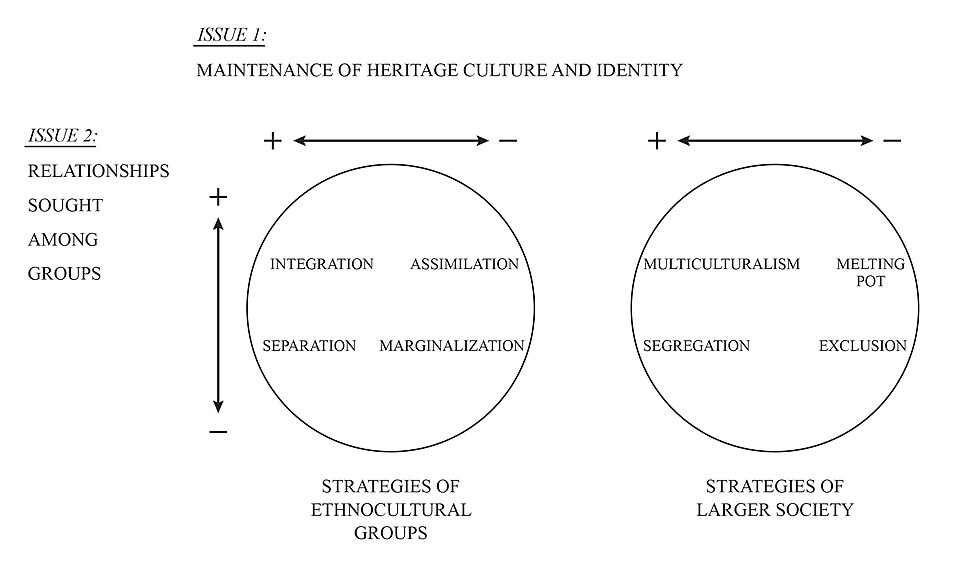
Berry’s acculturation model organizes acculturation into a 2×2 framework based on two questions: maintaining one’s heritage culture and participating in the host culture. The four quadrants map onto assimilation, integration, separation, and marginalization, which helps students explain strategy differences precisely in SAQs/ERQs. The “extended” labels also hint that broader social policies can shape which strategies are realistically available. Source
This produces four broad patterns:
Assimilation: adopting the new culture while giving up much of the original one
Integration: maintaining the original culture while also participating in the new culture
Separation: holding strongly to the original culture and limiting involvement with the new one
Marginalization: weak connection to both the original and the new culture
These patterns are not fixed labels. A person may integrate at school, separate at home, and shift over time as circumstances change.
Acculturative stress and adjustment
Adapting to a new cultural environment can create pressure and uncertainty.
Acculturative stress: Stress that results from the challenges of adapting to a new culture or balancing multiple cultural demands.
Sources of stress may include language barriers, discrimination, homesickness, unclear social rules, financial strain, or conflict between family expectations and the surrounding society. For example, parents and children may acculturate at different speeds, creating disagreements about autonomy, discipline, or identity.
The experience can be temporary or long term, and it may be stronger when people feel pressure to choose between cultures rather than combine them.
Adjustment outcomes vary. Some individuals develop bicultural competence, meaning they can function effectively across more than one cultural context. Others experience isolation, identity conflict, or reduced well-being. Outcomes are influenced by several factors:
whether cultural change is voluntary or forced
the degree of support from family and community
attitudes of the host society toward diversity
similarity or difference between the cultures in contact
access to education, work, and language learning
Common distinctions in exam answers
A common mistake is to treat enculturation and acculturation as the same process. They overlap, but the key difference is the context of learning. Enculturation usually refers to learning one’s culture as part of normal development. Acculturation refers to adapting when cultural contexts change or when two cultures come into ongoing contact.
Enculturation can continue across the lifespan as adults learn new roles within the same culture, but its main focus is still cultural transmission rather than intercultural adjustment.
Another useful distinction is that enculturation emphasizes internalizing norms, whereas acculturation emphasizes adjusting to change. Enculturation often supports continuity and belonging. Acculturation often involves negotiation, selective change, and possible stress.
Psychological explanations should also avoid assuming that acculturation is always one-way. In multicultural societies, cultural contact can reshape both minority and majority groups. This means acculturation is better understood as a dynamic process of adaptation rather than simple replacement of one culture by another.
Practice Questions
(2 marks): Define acculturation.
1 mark for stating that acculturation involves psychological and/or behavioral adjustment.
1 mark for stating that this adjustment happens after continuous contact with a different culture or cultural change.
(6 marks): Explain one factor that may influence acculturation outcomes.
1 mark for accurately identifying a relevant factor, such as social support, discrimination, language ability, or whether migration was voluntary.
1 mark for showing knowledge of acculturation as adaptation to a new cultural environment.
2 marks for explaining how the chosen factor affects adjustment, behavior, identity, or well-being.
1 mark for making the link to positive or negative acculturation outcomes clear.
1 mark for using a relevant example or context to support the explanation.
FAQ
Yes. Although it is strongest in childhood, enculturation can continue when adults enter new roles within the same cultural system.
Examples include becoming a parent, joining the military, entering a profession, or taking on community leadership. In each case, people learn new expectations, rituals, and responsibilities that are culturally defined.
Second-generation individuals often grow up with two strong cultural settings at once: the home and the wider society.
They may learn the heritage culture from family while learning the dominant culture through school, peers, and media. This can produce faster language shift, stronger bicultural identities, or greater conflict over values than in the first generation.
Researchers often use questionnaires that assess multiple areas rather than a single score.
Common measures include:
language preference
friendship networks
media use
food habits
cultural values
strength of identification with heritage and host cultures
Many psychologists prefer bidimensional measures, because a person can be strongly connected to both cultures at the same time.
Yes. Acculturation depends on sustained cultural contact, not only international migration.
It can happen through internal migration, attending a school dominated by a different cultural group, living in a colonized or multicultural setting, or growing up in a minority community within a larger national culture. Digital environments can also increase cultural contact, although direct daily interaction usually has stronger effects.
Bicultural identity integration refers to how compatible or conflicting a person experiences two cultural identities to be.
Someone with high bicultural identity integration may feel that both cultural backgrounds fit together naturally. Someone with low integration may feel torn between them. This matters because perceived compatibility can affect confidence, decision-making, and stress during acculturation.