IB Syllabus focus: 'Social identity theory and social learning theory explain and help change behaviour in social contexts.'
Human behavior in groups is shaped both by the identities people share and by the models they observe. These theories show why social contexts can produce, maintain, and change behavior.
Social Identity Theory
One major explanation of behavior in groups is social identity theory.
Social identity theory: A theory proposing that part of a person’s self-concept comes from membership in social groups, and that this affects attitudes and behavior toward in-groups and out-groups.
People do not act only as isolated individuals. In many situations, they think of themselves as members of a group, such as a nationality, sports team, school, religion, or friendship circle. When a group identity becomes important, people are more likely to follow group norms, defend the group, and compare their group with others.
Core processes in social identity theory
Social identity theory is usually explained through three linked processes:
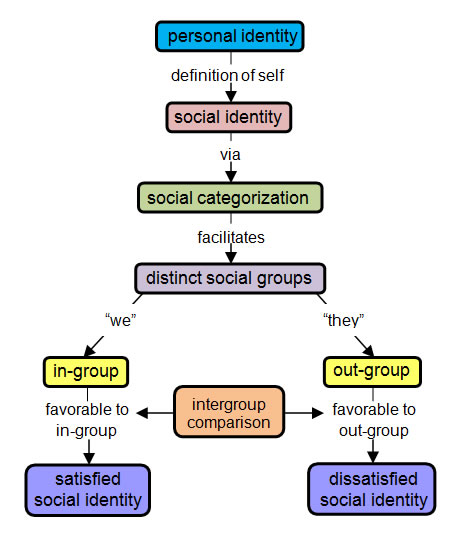
Flowchart of Tajfel & Turner’s social identity theory showing how social categorization leads to distinct “we” (in-group) vs. “they” (out-group) group boundaries, followed by intergroup comparison. It visually links these cognitive steps to outcomes such as more favorable evaluations of the in-group and changes in satisfaction with one’s social identity. Source
Social categorization: placing people, including ourselves, into groups
Social identification: adopting the identity and expected behavior of a group we belong to
Social comparison: comparing our group with other groups
These processes can produce in-group favoritism, where people prefer or support their own group, even when group divisions are weak or arbitrary. Tajfel’s minimal group studies showed that simply assigning people to groups could lead them to favor their own group.

Example of the point-allocation matrices used in Tajfel’s minimal group paradigm. These matrices operationalize in-group favoritism by forcing participants to choose distributions of rewards between an in-group member and an out-group member, making bias measurable even when group membership is trivial. Source
This suggests that shared identity alone can shape behavior.
A key idea is that people often want a positive social identity. If their group is seen positively, self-esteem may increase. As a result, people may act in ways that protect group status, copy group norms, or reject behaviors linked to an out-group. This helps explain behavior in school cliques, political groups, workplaces, and online communities.
Social identity theory also helps explain behavior change. If group norms change, individual behavior often changes with them. For example, if a peer group begins to value recycling, respectful language, or healthy habits, members may adjust their behavior to fit the group standard. In this way, social influence works through identity, not only through direct pressure.
Social Learning Theory
A second explanation of behavior in social settings is social learning theory.
Social learning theory: A theory proposing that people learn behavior by observing models, imitating them, and noticing the consequences of their actions.
This theory emphasizes that much human learning is observational. People do not need to experience reward or punishment directly. Instead, they can watch what happens to others and learn from those outcomes. This is called vicarious reinforcement when seeing another person rewarded makes imitation more likely, and vicarious punishment when seeing another person punished makes imitation less likely.
Conditions that make observational learning more likely
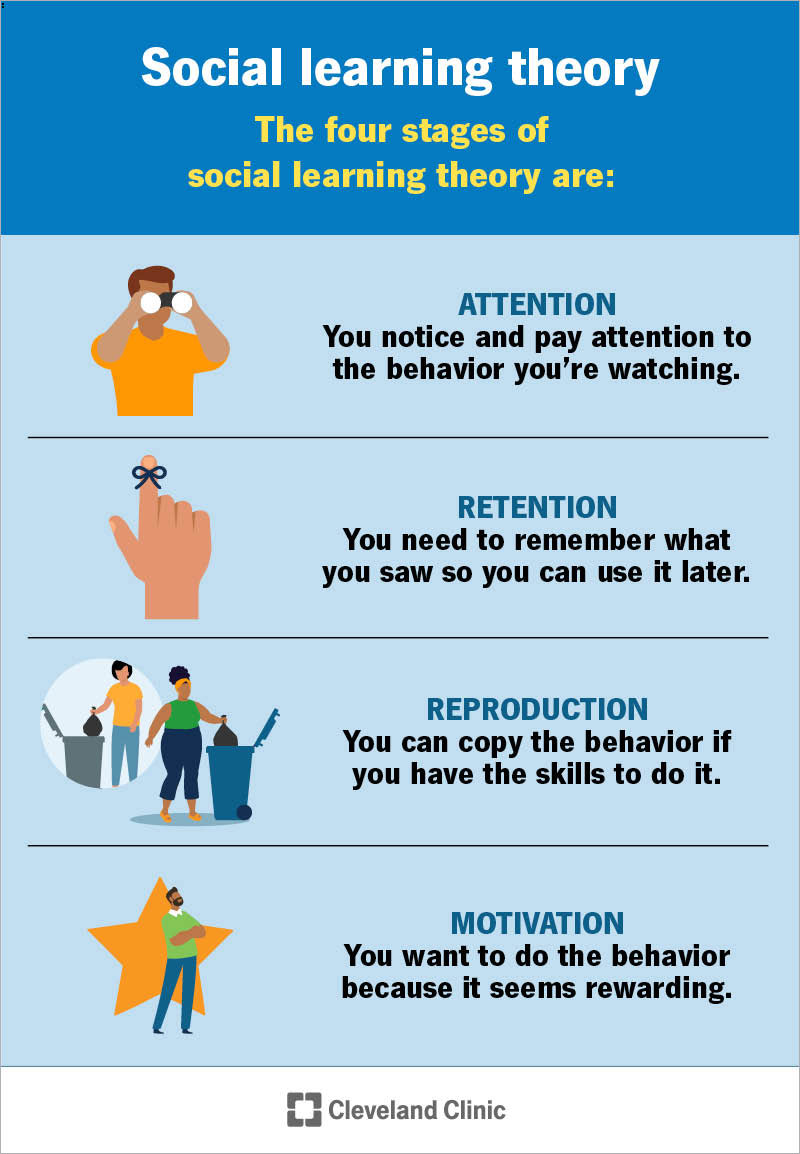
Diagram summarizing Bandura’s four stages of observational learning: attention, retention, reproduction, and motivation. It organizes the cognitive “mediators” between seeing a model’s behavior and later performing (or inhibiting) that behavior, which helps explain vicarious reinforcement and punishment. Source
Imitation is more likely when:
the model is seen as similar, high status, or attractive
the observer pays attention to the behavior
the behavior can be remembered
the observer feels able to reproduce it
the social context provides motivation to perform it
Bandura’s research on children and aggressive models showed that children can copy behavior they observe, especially when the model appears successful or unpunished. This was important because it showed that social contexts, including families, peers, and media, can transmit behavior patterns.
Social learning theory does not claim that people copy everything they see. Cognitive processes matter. A person may learn a behavior without performing it immediately. Performance depends on motivation, expectations, and whether the situation allows the behavior. This helps explain why different people respond differently to the same social model.
Using These Theories to Change Behavior
Both theories are valuable because they do not just explain behavior; they suggest ways to change it.
Applying social identity theory
Behavior change is often stronger when a message is tied to a meaningful shared identity. People may resist instructions from an out-group but accept the same message from an in-group leader. Because of this, psychologists and campaign designers often try to:
use respected in-group messengers
present desired behavior as part of “who we are”
reshape group norms so the new behavior becomes expected
create broader identities that reduce conflict between groups
For example, a school may reduce bullying more effectively by promoting a shared school identity that values inclusion, rather than only punishing individuals. Similarly, health campaigns can be more persuasive when they connect behavior to a valued group identity, such as “responsible teammates” or “caring families.”
Applying social learning theory
Social learning theory suggests that behavior change is more likely when people can see clear, credible models performing the target behavior. Useful strategies include:
showing prosocial models demonstrating the behavior
making positive consequences visible
using peers, teachers, parents, or media figures as role models
reinforcing the behavior after imitation
This approach is widely used in education, parenting, health promotion, and aggression prevention. For instance, if children repeatedly observe calm conflict resolution being rewarded, they are more likely to adopt that response themselves.
The two theories can also work together. People are especially likely to imitate a model when that model belongs to a group they identify with. This means social identity can shape who influences us, while social learning helps explain how that influence changes behavior.
Practice Questions
(3 marks): Outline one process in social identity theory that can influence behavior.
1 mark for identifying a relevant process such as social categorization, social identification, or social comparison
1 mark for accurately describing that process
1 mark for linking the process to behavior, such as following group norms or showing in-group favoritism
(6 marks): Explain one study related to social learning theory and how it shows that behavior can be shaped by social context.
1 mark for outlining social learning theory
1 mark for explaining modeling or vicarious reinforcement/punishment
2 marks for accurate knowledge of one relevant study, such as aim, method, and findings
1 mark for explaining what the findings show about learned behavior
1 mark for clearly linking the study to the role of social context in shaping behavior
FAQ
Personal identity refers to qualities that make someone unique, such as their memories, traits, and preferences.
Social identity comes from group memberships, such as being an athlete, student, or member of a cultural group. In many situations, whichever identity is most salient has the strongest effect on behavior.
Yes. People usually belong to many groups at the same time, and these identities can overlap.
Which identity guides behavior depends on factors such as:
the immediate setting
who else is present
whether a group feels threatened
which group norms are most visible
They can. Social learning theory includes symbolic models, such as characters in films, games, or social media content.
Learning from media is often stronger when:
the model seems realistic
the viewer identifies with the model
the behavior is repeated often
the behavior appears rewarded socially
Learning and performance are not always the same thing. A person may store a behavior in memory without showing it immediately.
Later, the behavior may appear when:
the situation seems appropriate
the person expects a reward
peers approve of it
an opportunity finally appears
Social identity helps explain why people join trends linked to a valued online community or hashtag. Taking part can signal belonging.
Social learning helps explain how the trend spreads:
users observe many models
rewards are highly visible through likes and shares
imitation becomes easier through repeated exposure