IB Syllabus focus: 'Cultural dimensions and cognitive dissonance help explain cross-cultural differences, similarities and human behaviour.'
This topic links cultural value patterns with attitude-behavior consistency, showing why people in different societies may think, choose, and justify actions differently while still sharing basic psychological processes.
Cultural dimensions as a framework
Cultural dimensions are broad patterns of shared values used to compare cultures. They do not describe every individual, but they help psychologists identify recurring differences and similarities in social behavior, thinking, and motivation.
Cultural dimensions: Broad value patterns used to compare cultures on recurring social priorities, expectations, and preferred ways of behaving.
These dimensions are usually treated as continua rather than fixed categories.

This diagram represents individualism and collectivism as opposite ends of a single continuum. It helps illustrate that cultures (and people within cultures) can fall at different points between prioritizing personal autonomy (“I”) and prioritizing group interdependence (“we”), rather than belonging to one rigid category. Source
A culture may lean more toward one end, while people within it still vary by age, region, social class, and situation. For IB Psychology, their main value is explanatory: they connect culture to common behavioral trends.
Individualism and collectivism
The most frequently used cultural dimension in psychology is individualism-collectivism. Individualistic settings emphasize personal goals, independence, and self-expression. Collectivistic settings emphasize interdependence, group harmony, and social obligation.
This difference can influence:
how people define the self
whether decisions are framed as personal choices or group responsibilities
how strongly people prioritize harmony over direct disagreement
whether success and failure are interpreted as individual or relational outcomes
These patterns are often linked to different views of the self. In some contexts, the self is understood mainly as separate and autonomous; in others, it is understood more through relationships and social roles. This matters because inconsistency may threaten personal identity in one setting but threaten group harmony in another.
Even so, both orientations exist in all societies. The key point is that culture changes which responses are more strongly rewarded and therefore more common.
Other useful dimensions
Other cultural dimensions can also shape behavior. Power distance refers to acceptance of unequal status and authority. Higher power distance may be linked to stronger deference to leaders, teachers, or parents, while lower power distance may encourage questioning and negotiation. Uncertainty avoidance refers to how strongly a culture prefers rules, predictability, and reduced ambiguity. This can influence reactions to risk, novelty, and social change.
For example, a high uncertainty-avoidance setting may encourage stronger justification of rule-following after difficult decisions, whereas lower uncertainty avoidance may normalize ambiguity and reduce pressure for immediate consistency.
These dimensions help researchers avoid assuming one culture is the default. However, they are broad averages, so they should be used carefully and not as stereotypes.
Cognitive dissonance across cultures
Cognitive dissonance is central to understanding how culture influences consistency between attitudes and behavior.
Cognitive dissonance: Psychological discomfort caused by inconsistency between beliefs, attitudes, or behavior, often motivating a person to reduce that inconsistency.
According to dissonance theory, people try to reduce discomfort caused by inconsistency.
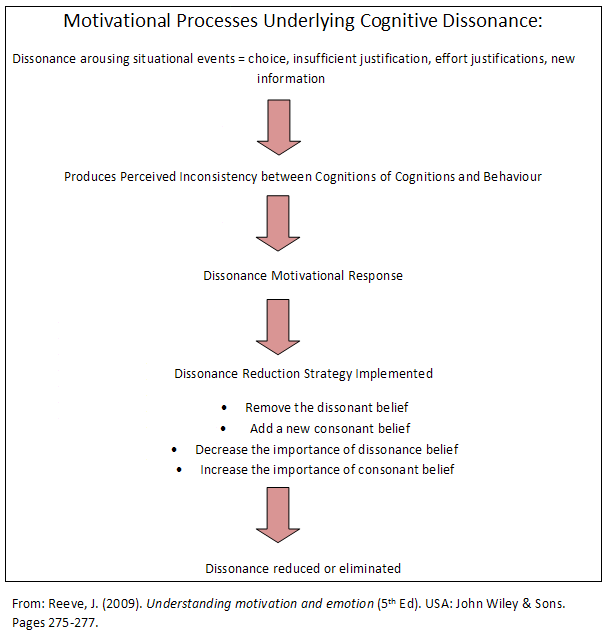
This diagram summarizes cognitive dissonance as a motivational process: perceived inconsistency creates an aversive arousal state that prompts efforts to restore consistency. It is useful for exam-style explanations because it depicts the general mechanism (discomfort leading to reduction) independent of any one cultural context or example. Source
Common responses include:
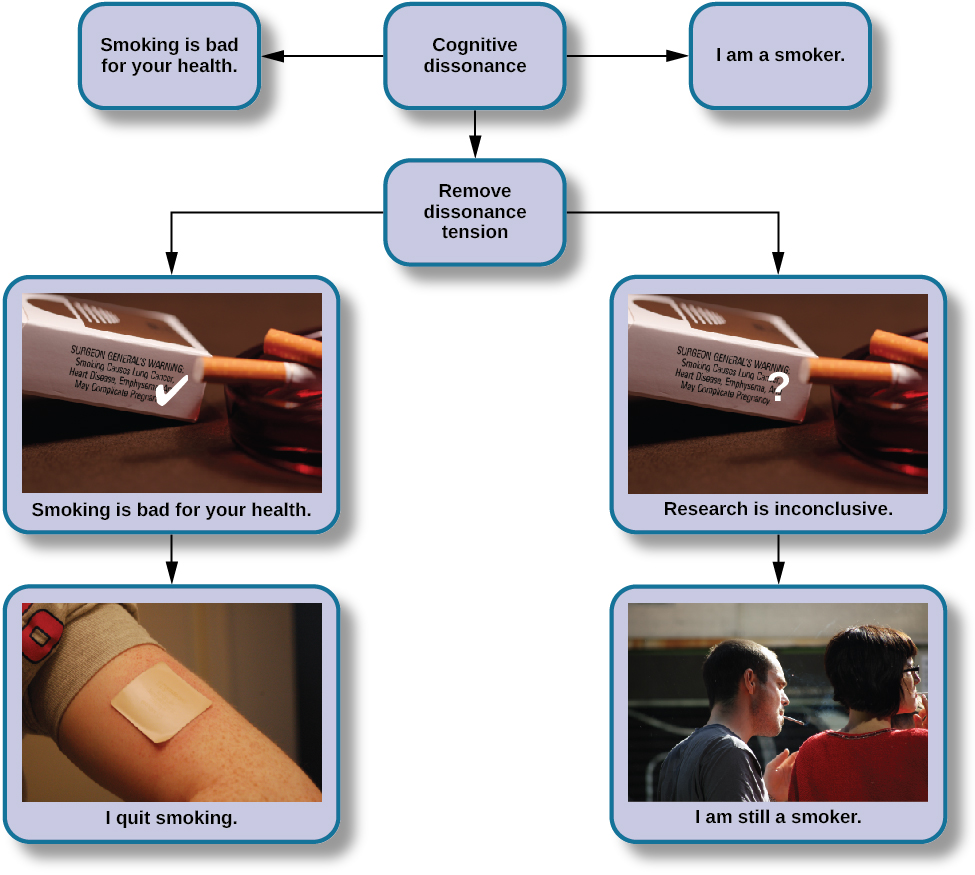
This flow diagram shows cognitive dissonance as a tension state created by inconsistent cognitions (e.g., a health belief vs. smoking behavior). It then illustrates multiple reduction routes—changing behavior (quit) or changing/adding cognitions (rationalize/deny)—which matches the core mechanisms emphasized in dissonance theory. Source
changing an attitude
changing a behavior
adding a new justification
minimizing the importance of the conflict
Dissonance can appear after decisions, effort, hypocrisy, or forced compliance. The cross-cultural issue is not whether these processes exist, but which situations make them psychologically meaningful.
Why culture shapes dissonance
Culture affects which inconsistencies matter most. In more individualistic cultures, dissonance is often strongest when a person’s private attitudes conflict with freely chosen behavior. Personal choice and internal consistency are highly valued, so acting against one’s own preferences can feel especially uncomfortable.
In more collectivistic cultures, dissonance may be shaped more by relationships and social roles. A conflict may feel stronger when behavior threatens harmony, obligation, or the expectations of important others. This means dissonance is not absent; instead, it may be triggered by different kinds of inconsistency.
A useful comparison is:
individualistic contexts often emphasize consistency within the personal self
collectivistic contexts often emphasize consistency within the relational self
This helps explain both cross-cultural differences and similarities. People across cultures seek coherence, but the social meaning of coherence is not always the same.
Research evidence
Cross-cultural research supports this pattern. Heine and Lehman (1997) found that Canadian participants showed the classic post-decisional dissonance effect more strongly than Japanese participants in a free-choice task. This suggested that personal choice may create more dissonance in cultures where autonomy is strongly emphasized.
However, later work showed a more nuanced picture. Kitayama et al. (2004) found that Japanese participants were more likely to show dissonance when their choices had interpersonal relevance, such as when significant others were involved. This suggests that collectivistic cultures may experience dissonance in socially meaningful situations rather than only in isolated personal-choice settings.
The free-choice paradigm should be interpreted carefully, because some researchers argue that ranking tasks can create artificial preference shifts. Even so, cross-cultural findings remain useful when methods are culturally sensitive.
Together, these studies show that cultural dimensions can refine, rather than replace, general psychological theories.
Evaluation and exam focus
When evaluating this topic, focus on both usefulness and limits.
Strengths:
cultural dimensions offer a clear framework for comparing societies
cognitive dissonance research shows that broad psychological processes can be culturally shaped
cross-cultural findings make psychology less ethnocentric
Limitations:
national culture scores can hide large within-culture differences
people may shift between cultural styles depending on language, setting, or audience
tasks developed in Western contexts may not measure dissonance equally well everywhere
cultural dimensions describe patterns, but they do not fully explain behavior on their own
In essays, strong answers connect a specific cultural dimension, usually individualism-collectivism, to how and why dissonance is experienced differently across cultures.
Practice Questions
(2 marks) State one way cultural dimensions help explain cross-cultural differences in behavior.
1 mark for identifying a relevant cultural dimension, such as individualism-collectivism, power distance, or uncertainty avoidance.
1 mark for linking that dimension to a behavioral difference across cultures.
(6 marks) Explain how cognitive dissonance may be influenced by culture.
1 mark for defining cognitive dissonance.
1 mark for identifying a relevant cultural dimension, usually individualism-collectivism.
2 marks for explaining how culture changes the situations that produce dissonance, such as personal choice versus social obligation.
1 mark for using relevant research or a cross-cultural example.
1 mark for showing that dissonance may be a broad process but can be triggered or expressed differently across cultures.
FAQ
Researchers usually start with the behavior or attitude they want to explain. If the topic involves autonomy, choice, or self-expression, individualism-collectivism is often most relevant. If it involves hierarchy, power distance may fit better.
They also consider:
whether a validated scale already exists
whether the dimension makes sense in that cultural setting
whether pilot testing shows participants interpret items as intended
Small wording differences can change the meaning of key ideas such as “choice,” “responsibility,” or “regret.” If those terms are translated poorly, the study may not be measuring the same psychological experience across groups.
Researchers often use:
back-translation
bilingual reviewers
cultural adaptation, not just literal translation
This improves linguistic equivalence and helps reduce misleading cross-cultural differences.
Yes. Bicultural individuals may shift between cultural frames depending on language, setting, or social cues. This is sometimes called frame switching.
For example, the same person may focus more on personal preference in one context and more on family obligation in another. That means dissonance responses are not always fixed traits; they can be activated by the immediate cultural environment.
The ecological fallacy is the mistake of taking a group-level pattern and assuming it applies to every individual in that group.
This matters because national culture scores describe averages, not people. A country may score as relatively collectivistic, but many individuals within it may act in highly individualistic ways. Good interpretation keeps group trends and individual differences separate.
One criticism is that changes in rankings after a choice may reflect memory effects or measurement artifacts rather than genuine dissonance reduction.
Because of this, some researchers prefer methods such as:
public commitment tasks
hypocrisy paradigms
designs that hide the initial choice process
These alternatives aim to test dissonance more directly and reduce the risk of overinterpreting preference changes.