AP Syllabus focus:
‘The sleep/wake cycle is a circadian rhythm of about 24 hours in humans, and jet lag or shift work can disrupt it.’
The sleep/wake cycle is governed by internal biological timing systems that help coordinate alertness and sleepiness across the day. Understanding circadian rhythms explains why timing, light exposure, and schedules strongly shape sleep quality and daytime functioning.
Circadian Rhythms and the Sleep/Wake Cycle
Circadian rhythm: an internal biological cycle, close to 24 hours, that regulates daily patterns such as sleepiness and alertness.
Humans show a near-24-hour pattern in sleep timing even without clocks, but it is continuously adjusted by environmental cues.
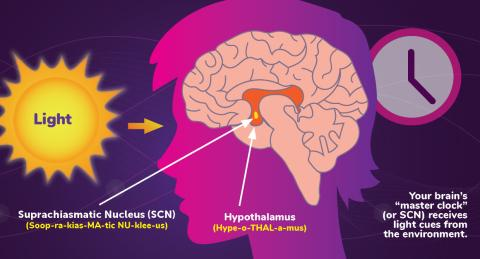
This infographic highlights the suprachiasmatic nucleus (SCN) as the brain’s “master clock” and situates circadian rhythms as 24-hour patterns that coordinate physiology and behavior. It provides a high-level visual anchor for how an internal timing system can stay stable yet still be adjusted by cues such as light. Source
The sleep/wake cycle is therefore both endogenous (internally generated) and entrainable (able to be reset).
Core biological clock
A key structure coordinates circadian timing across the body.
Suprachiasmatic nucleus (SCN): a small cluster of cells in the hypothalamus that acts as the body’s primary circadian “clock,” synchronising daily rhythms.
The SCN helps align the sleep/wake cycle by integrating information about the light–dark cycle and coordinating downstream processes that influence arousal and sleepiness.
Zeitgebers: environmental time cues
Zeitgeber: an external cue (especially light) that resets or synchronises circadian rhythms to the local day.
Important zeitgebers that influence the sleep/wake cycle include:
Light exposure (strongest cue), particularly in the morning versus evening
Regular sleep and wake times
Daily patterns of activity, meals, and social schedules
When zeitgebers are consistent, circadian timing and sleep opportunity tend to align, supporting stable alertness in the day and consolidated sleep at night.
What “About 24 Hours” Means in Practice
The circadian system does not simply “turn sleep on and off.” Instead, it shapes:
A daily rhythm of sleep propensity (likelihood of falling asleep)
A daily rhythm of alertness (ease of staying awake and attentive)
Because this rhythm is approximately 24 hours, it fits typical day–night schedules well. However, when the environment changes faster than the circadian clock can adjust, misalignment occurs.
Disruptions: Jet Lag and Shift Work
Jet lag
Jet lag: circadian misalignment that occurs after rapid travel across time zones, producing sleepiness, insomnia, and reduced daytime alertness at the “wrong” local times.
Jet lag reflects a mismatch between:
The internal circadian clock (still set to the departure time zone)
The new local light–dark cycle and schedule demands
Common effects include difficulty falling asleep or waking at desired times, daytime fatigue, and impaired concentration—because the sleep/wake rhythm is still “predicting” the old time zone.
Shift work (and shift-work misalignment)
Shift work: employment schedules that require working during typical sleep hours (e.g., night shifts), often disrupting circadian alignment.
Shift work can disrupt the sleep/wake cycle because:
Work requires alertness when circadian rhythms promote sleep
Daytime sleep occurs when circadian rhythms promote wakefulness
Light exposure during night work and morning commuting can send conflicting signals to the circadian clock
As a result, people may experience shortened or fragmented sleep and reduced performance, especially during overnight schedules.
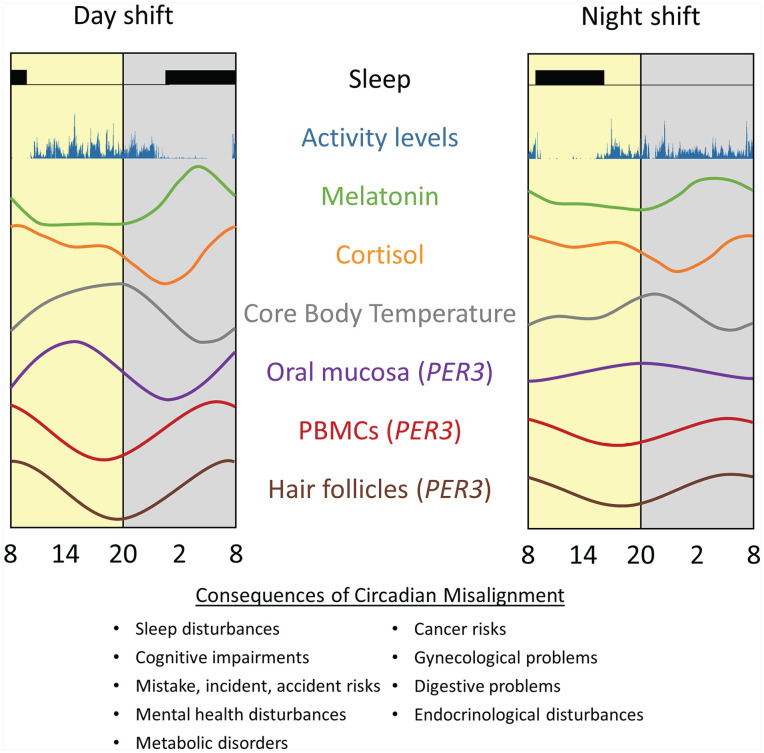
This figure schematically contrasts a typical day-oriented rhythm with a night-shift schedule, illustrating how internal circadian markers (e.g., melatonin and related central rhythms) can remain misaligned when behavior is forced to shift. The diagram makes the concept of “circadian misalignment” concrete by visually separating the external light–dark cycle from the timing of sleep/work. Source
Key takeaways for AP-level understanding (within this subtopic)
The sleep/wake cycle is a circadian rhythm with a period of about 24 hours in humans.
Jet lag and shift work can disrupt this rhythm by forcing sleep and wakefulness at times that conflict with internal biological timing.
Light and daily routines serve as powerful cues that influence how quickly the circadian system aligns with a new schedule.
Practice Questions
Explain what is meant by the statement that the human sleep/wake cycle is “a circadian rhythm of about 24 hours.” (2 marks)
1 mark: States that the sleep/wake cycle follows an internal biological pattern/rhythm.
1 mark: States that the cycle repeats roughly every 24 hours (daily timing of sleepiness/alertness).
Describe how jet lag or shift work can disrupt the sleep/wake cycle. In your answer, refer to circadian rhythms and at least one environmental cue. (5 marks)
1 mark: Identifies disruption as circadian misalignment (internal clock out of sync with schedule/local time).
1 mark: Links misalignment to sleep at an atypical biological time (insomnia or sleepiness at “wrong” time).
1 mark: Explains impact on daytime alertness/performance due to mismatch.
1 mark: Applies to jet lag (rapid time-zone change causing internal clock to lag behind local time).
1 mark: Mentions an environmental cue/zeitgeber (e.g., light) affecting re-synchronisation.
FAQ
Evening light can delay circadian timing by signalling “daytime” later than usual, making sleepiness arrive later. Morning light more often advances timing, supporting earlier sleep and wake.
Social jet lag is a mismatch between weekday and weekend sleep schedules (e.g., sleeping late on weekends). Unlike travel jet lag, the time zone stays the same; the conflict is between social timing and internal rhythms.
Chronotype reflects a person’s preferred circadian phase. “Owls” tend to feel alert later and sleepy later; “larks” shift earlier. Differences arise from biology plus light exposure and routines.
Melatonin can shift circadian phase depending on when it is taken relative to internal timing. Taken at the wrong time, it may have little benefit or shift timing in an unintended direction.
Frequent rotation prevents the circadian system from settling into a consistent pattern. Stable schedules allow more consistent light exposure and sleep timing, which supports stronger entrainment (even if imperfect).