AP Syllabus focus:
‘Sleep may help restore depleted resources and organize or consolidate memories.’
Sleep is an active biological state that supports brain and body functioning.
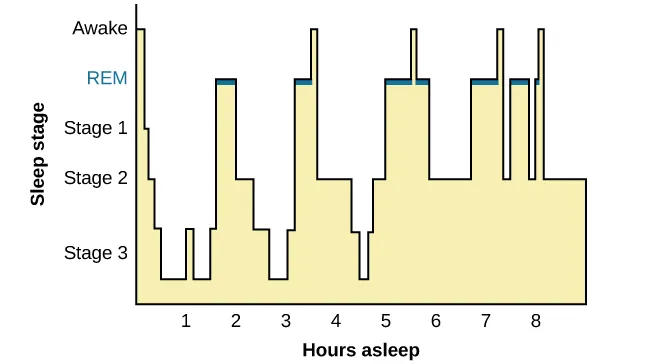
This hypnogram shows a typical overnight pattern of sleep stages across time, illustrating repeated cycles of NREM and REM sleep rather than a single uniform state. Visually, it highlights how deeper NREM sleep is concentrated earlier in the night, while REM periods become more prominent later—supporting the idea that sleep involves coordinated, changing brain activity. Source
AP Psychology emphasises two core functions: restoring depleted resources and organising or consolidating memories to improve later thinking and performance.
Core function 1: Restoring depleted resources
Sleep is often explained through restorative (recuperative) theories, which propose that waking activity gradually depletes biological resources and sleep helps rebuild them.
Restorative theory of sleep: The view that sleep replenishes physical and mental resources drained during waking life.
What “restoration” means in AP Psych terms
Restoration refers to processes that help the body and brain return toward baseline after daily wear-and-tear.
Energy balance: Waking cognition and movement consume energy; sleep reduces overall demand and supports recovery.
Tissue repair and maintenance: Many growth and repair processes are more active during sleep, supporting recovery from daily micro-damage.
Immune functioning support: Sleep loss is associated with poorer resistance to illness, consistent with sleep’s role in maintaining health.
Brain “resetting” for alertness: Adequate sleep supports sustained attention, emotional control, and efficient thinking the next day, implying a recuperative function.
Evidence patterns students should recognise
You do not need to memorise specific studies to understand the logic of restorative explanations, but you should recognise these common findings:
When people sleep less, they tend to show fatigue, reduced attention, and worse mood regulation, suggesting incomplete recovery.
After unusually demanding physical or mental days, people may experience increased sleep drive, consistent with resource depletion and replenishment.
Core function 2: Organising and consolidating memories
A second major function is that sleep helps stabilise what was learned during the day.
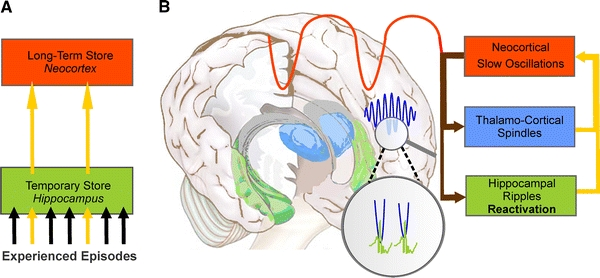
This diagram summarizes the two-stage (systems) model of memory consolidation during slow-wave sleep: newly encoded information is temporarily supported by the hippocampus, then repeatedly reactivated and redistributed to longer-term neocortical networks. It also depicts how coordinated brain rhythms (slow oscillations, thalamocortical spindles, and hippocampal sharp-wave ripples) can temporally align this reactivation to promote stabilization and reorganization of memories. Source
This matches the syllabus phrasing that sleep may “organize or consolidate memories.”
Memory consolidation: The process of strengthening and stabilising newly formed memories so they are more likely to be retained and retrieved later.
Memory consolidation is not only about “saving” information; it also involves organisation—integrating new material with existing knowledge so it becomes easier to access and use.
How sleep supports learning and remembering
Key ideas to know at AP level:
Strengthening new learning: Sleep can improve later recall/recognition relative to an equivalent period of wakefulness.
Reducing interference: During wakefulness, new experiences can overwrite or disrupt fragile memories; sleep can protect them from competing input.
Organisation of information: Sleep may help the brain detect patterns and connections (for example, linking related concepts), making memories more usable.
What kinds of memory are most relevant here
AP Psychology often distinguishes between different memory systems; for this subtopic, focus on sleep’s broad role in learning rather than detailed stage-by-stage claims.
Declarative learning (facts and events) benefits when sleep follows studying, supporting retention.
Skill learning (practiced behaviours) can also improve after sleep, consistent with off-line processing.
Nature–nurture framing: why functions matter
The “why we sleep” question is about adaptive value: if sleep restores resources and consolidates memories, then sleep supports survival by improving health, performance, and learning capacity.
Restoration helps the organism function physically and emotionally.
Consolidation/organisation helps the organism use past experience to guide future behaviour.
Practice Questions
Explain one way sleep helps the brain “restore depleted resources.” (2 marks)
1 mark: Identifies a valid restorative effect (e.g., reduces fatigue by replenishing energy, supports tissue repair, supports immune functioning, improves next-day alertness).
1 mark: Brief explanation linking sleep to recovery from depletion during waking (e.g., waking drains resources; sleep allows replenishment/repair).
Discuss the idea that sleep helps “organise or consolidate memories.” Include one mechanism-like explanation and one practical implication for learning. (5 marks)
1 mark: Defines or accurately describes memory consolidation (stabilising/strengthening new memories).
1 mark: Explains organisation/integration (linking new information with existing knowledge or extracting patterns).
1 mark: Mechanism-like explanation (e.g., reduced interference from new input; off-line strengthening).
1 mark: Practical implication stated (e.g., sleeping after studying can improve later recall/performance).
1 mark: Clear linkage to the syllabus claim (sleep supports memory retention/organisation).
FAQ
Research suggests the brain increases fluid-based clearance of metabolic by-products during sleep (often discussed as “glymphatic” activity).
This is proposed as one reason sleep feels mentally refreshing, though the exact causal links to cognition are still being studied.
Sleep loss may leave newly learned material in a more fragile state.
It can also reduce attention and working memory the next day, making retrieval harder even when the information is partly stored.
Many findings suggest a shorter gap between learning and sleep can reduce interference from new experiences.
However, the best timing can depend on what you learned and how much competing information you encounter before sleeping.
Naps can support alertness and some memory benefits, especially when they are long enough to include deeper sleep.
The trade-off is “sleep inertia” (grogginess) immediately after waking for some people.
Differences can reflect genetics, age, stress load, and baseline sleep quality.
Individual variation in how efficiently someone consolidates information during sleep may also contribute, even when total hours are similar.