AP Syllabus focus:
‘NREM sleep occurs in Stages 1 through 3, decreases in duration across the cycle, and includes hypnagogic sensations as sleep begins.’
NREM sleep is the set of sleep stages that typically dominates the first part of the night and supports physical restoration. Understanding Stages 1–3 and hypnagogic sensations clarifies how sleep begins and deepens.
What NREM Sleep Is
NREM sleep is the non–rapid eye movement portion of sleep that progresses from light to deep sleep across Stages 1 through 3.
NREM sleep: Sleep that occurs without rapid eye movements and is organised into Stages 1–3, ranging from light sleep to deep, slow-wave sleep.
NREM is often contrasted with REM, but here the focus is on how NREM begins, deepens, and changes across the night.
Stages 1–3: How NREM Deepens
Stage 1 (N1): Transition into Sleep
Stage 1 is the entry point from wakefulness into sleep and is typically brief.
Awareness fades and attention to the environment drops.
People may feel they are “not asleep,” yet responsiveness is reduced.
This stage is where sleep onset phenomena are most likely.
Stage 2 (N2): Stable Light Sleep
Stage 2 marks a more stable sleep state than Stage 1.
The body further relaxes (reduced muscle tension and slower overall activity).
It is harder to awaken someone than in Stage 1.
Stage 2 commonly makes up a substantial share of total sleep time across the night.
Stage 3 (N3): Deep Sleep (Slow-Wave Sleep)
Stage 3 is the deepest NREM stage and is strongly associated with physical restoration.
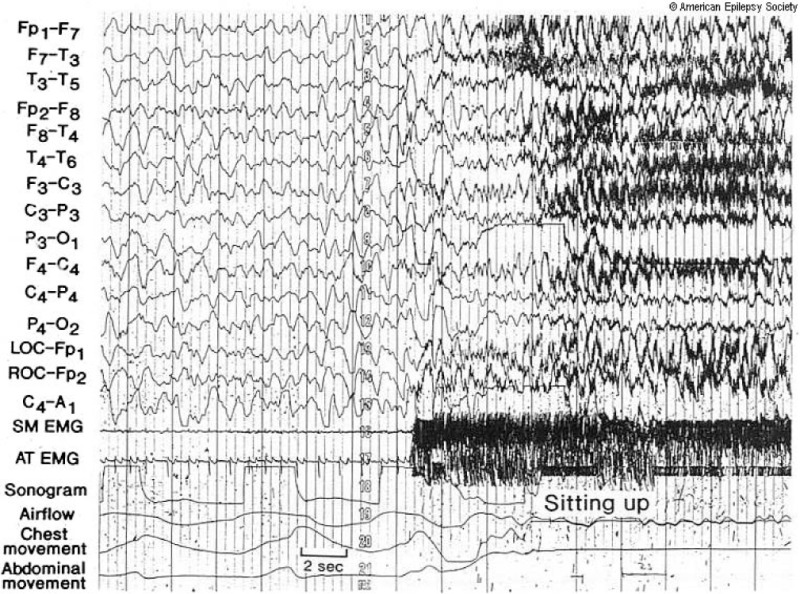
This EEG figure shows an epoch of N3 (slow-wave) sleep, characterized by prominent, high-amplitude, low-frequency delta activity. It helps anchor the definition of Stage 3 as “deep sleep” in a measurable physiological signature rather than a purely behavioral description. Seeing the waveform pattern makes it easier to distinguish N3 from lighter NREM stages in sleep-science contexts. Source
Arousal threshold is highest (awakening is difficult).
If awakened, a person is more likely to feel groggy and disoriented (sleep inertia).
This stage is especially important early in the night, when deep sleep pressure is greatest.
NREM Across the Night: “Decreases in Duration Across the Cycle”
Sleep is organised into repeating cycles; within these cycles, NREM sleep occurs in Stages 1–3.
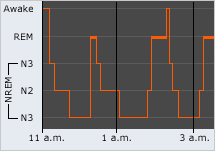

This Harvard sleep-education figure set depicts how sleep is organized into repeating NREM–REM cycles across the night, with deeper NREM appearing more strongly earlier and REM bouts tending to lengthen later. The accompanying NREM EEG image highlights that NREM is subdivided into three stages (N1–N3) with progressively slower, more synchronized brain activity. Together, the visuals link your stage definitions to real sleep-architecture patterns. Source
Across successive cycles, NREM decreases in duration, largely due to a reduction in Stage 3 deep sleep as the night progresses.
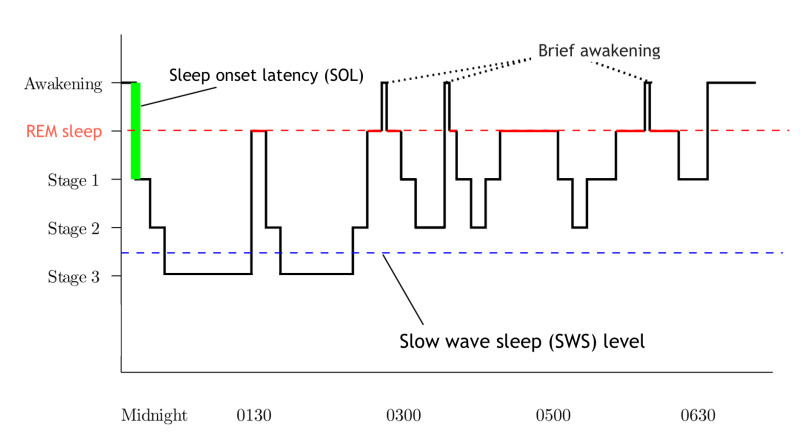
This hypnogram plots a typical night of sleep, showing repeated cycles through NREM stages (N1–N3) and REM. It visually reinforces that the deepest NREM sleep (N3) is concentrated earlier in the night, while later cycles contain less N3 and relatively more lighter sleep and REM. Use it to connect the idea of “sleep cycles” to the observable pattern of changing stage durations across the night. Source
Early night: proportionally more Stage 3 (deeper NREM).
Later night: proportionally less Stage 3, with sleep tending to be lighter overall within NREM.
This shift is a key architectural feature: deep NREM is front-loaded, and later sleep contains less of it.
Hypnagogic Sensations: Sleep’s “On-Ramp”
As sleep begins (most often during Stage 1), many people experience brief, vivid sensations that feel surprisingly real.
Hypnagogic sensations: Perceptual experiences at sleep onset (as one is falling asleep), such as feeling of falling, floating, hearing a noise, or seeing fleeting imagery.
A useful way to remember them is that hypnagogic = going into sleep (as opposed to waking up).
Common Forms of Hypnagogic Sensations
Hypnic jerk (sleep start): a sudden muscle contraction, sometimes paired with a “falling” feeling.
Brief visual imagery: flashes of light, faces, or scene-like fragments.
Auditory impressions: hearing one’s name, a bang, or a ringtone-like sound.
Somatic distortions: floating, shrinking/growing sensations, or mild tingling.
Why They Matter for AP Psychology
Hypnagogic sensations show that consciousness changes gradually, not like a switch.
They help explain why people may misinterpret sleep onset experiences as external events.
They illustrate the boundary between wakeful awareness and early NREM sleep (Stage 1).
Practice Questions
Define hypnagogic sensations and state when they typically occur. (2 marks)
1 mark: Correct definition (sleep-onset perceptual experiences).
1 mark: Correct timing (as one is falling asleep; typically Stage 1/N1).
Describe NREM sleep in terms of its stages and how it changes across the night, including reference to hypnagogic sensations. (5 marks)
1 mark: States NREM occurs in Stages 1–3.
1 mark: Describes Stage 1 as the transition into sleep (lightest NREM).
1 mark: Describes Stage 3 as deepest NREM / hardest to awaken (slow-wave/deep sleep idea).
1 mark: Explains NREM decreases in duration across the cycle (especially reduced Stage 3 later in the night).
1 mark: Links hypnagogic sensations to sleep onset (typically Stage 1).
FAQ
Often they are normal. Concern increases if they are frequent, distressing, or paired with dangerous behaviours or significant daytime sleepiness.
Common contributors include stress, irregular sleep schedules, heavy caffeine intake, and sleeping in an unfamiliar environment.
Not everyone recalls them. They are more likely to be noticed when someone is anxious about falling asleep or becomes briefly alert during sleep onset.
Researchers typically identify deep sleep using polysomnography features (especially slow-wave activity), then quantify minutes or percentage of total sleep time spent in Stage 3.
Relaxation may reduce perceived startle and anxiety at sleep onset, which can make hypnagogic sensations less disruptive and less memorable, even if they still occur.