AP Syllabus focus:
‘Theories about dreams include activation-synthesis and consolidation theory.’
Dreams are subjective experiences that can feel vivid, emotional, and story-like. Psychologists use theories to explain why dreams happen and what they might represent about brain activity and information processing during sleep.
Why psychologists theorise about dreams
Dream theories in AP Psychology focus on linking dream content to underlying brain processes. Two influential approaches differ in whether dreams are mainly a by-product of neural activation or serve a functional role in strengthening memory.
Key goals of dream theories:
Explain why dream narratives can be strange (shifts in time, place, and identity)
Account for emotionally intense dream content
Connect dreaming to known sleep-related brain activity and memory processes
Activation-synthesis theory
Activation-synthesis emphasises physiology first: the sleeping brain generates activation, and the mind builds a story from it.
Activation-synthesis theory: The view that dreams result when the brain’s spontaneous neural activity during sleep is “synthesised” by the cortex into a narrative the person experiences as a dream.
Core idea
During sleep, especially when internal activation is high, the brain produces random or semi-random signals
The cerebral cortex attempts to impose meaning and coherence on this activation
The “dream” is the brain’s best-guess interpretation, not a deliberately constructed message
What it helps explain (AP-relevant)
Bizarre plot shifts: if input signals are fragmented, the story can become discontinuous
Odd combinations of memories and sensations: the cortex may stitch together unrelated elements
Reduced rational control: dream logic can differ from waking logic if control systems are less engaged
Common evaluation points
Strength: offers a clear, biologically grounded explanation for why dreams can be illogical and unexpected
Limitation: people often report stable themes (relationships, fears, goals) that can seem more organised than “random synthesis” alone would predict
Consolidation theory
Consolidation theory treats dreaming as connected to memory consolidation—the process by which newly encoded information becomes more stable and integrated.
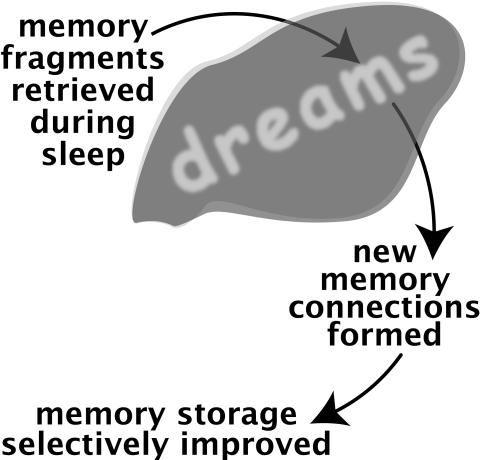
Schematic diagram illustrating how memories can be reactivated during sleep and gradually reorganized/strengthened as part of consolidation. The visual emphasizes that sleep-related processing can involve reactivation and integration across distributed networks rather than a literal “replay” of the day. This supports consolidation theory’s claim that dream content may reflect ongoing memory processing. Source
Consolidation theory: The view that dreaming is linked to the brain’s consolidation of memories, helping stabilise, integrate, and reorganise information (including emotional material) during sleep.
This approach does not require dreams to be perfectly accurate replays. Instead, dream content may reflect the brain processing and reorganising experiences.
Core idea
During sleep, the brain reactivates and reorganises elements of recent learning and older knowledge
Dream content may be a subjective by-product of that reactivation, or it may reflect a process that supports:
strengthening useful memories
integrating new information with existing schemas
processing emotional experiences tied to memory
What it helps explain (AP-relevant)
Incorporation of recent experiences (“day residue”): fragments of recent events show up in dreams
Emotion-laden dreams: emotionally significant memories are often prioritised in consolidation
Mixing old and new: reorganisation can blend prior knowledge with new learning, producing novel dream scenarios
Common evaluation points
Strength: fits broader evidence that sleep supports learning and memory performance, implying sleep-related processing has function
Limitation: it is difficult to prove that dreaming itself (rather than sleep generally) causes consolidation; dream reports are also imperfect and influenced by recall
Comparing activation-synthesis and consolidation theory
How they differ
Activation-synthesis: dreams are primarily the cortex interpreting internally generated activation; meaning is constructed after the fact
Consolidation: dreams are tied to memory processing; meaning may reflect which information the brain is strengthening or integrating
How they can be distinguished in answers
Use theory-specific language:
Activation-synthesis: “random neural firing,” “brainstem activation,” “cortex synthesises a story,” “by-product”
Consolidation: “memory consolidation,” “reactivation,” “integration,” “processing emotional experiences”
What to avoid mixing up
Neither theory requires the claim that dreams are literal predictions or supernatural messages
Consolidation theory is about memory processing, not simply “dreams replay the day exactly”
Activation-synthesis does not mean dreams are meaningless to the person; it claims the source is neural activation rather than a planned message
Practice Questions
Outline the activation-synthesis theory of dreaming. (2 marks)
1 mark: States that dreams begin with spontaneous/random neural activity during sleep.
1 mark: States that the cortex organises/synthesises this activity into a coherent narrative experienced as a dream.
Compare activation-synthesis theory and consolidation theory as explanations of dreaming. Include one limitation for each theory. (6 marks)
1 mark: Activation-synthesis—dreams arise from internally generated neural activation.
1 mark: Activation-synthesis—cortex synthesises/constructs a story from that activation.
1 mark: Consolidation—dreaming is linked to memory consolidation/processing during sleep.
1 mark: Consolidation—dream content reflects reactivation/integration of information (often including emotional material).
1 mark: Limitation of activation-synthesis (e.g., does not fully explain recurring themes/organised content).
1 mark: Limitation of consolidation (e.g., difficult to show dreaming itself causes consolidation; dream reports are unreliable).
FAQ
Yes. One possibility is that spontaneous activation provides the raw material, while consolidation processes bias which memories are reactivated.
In that hybrid view, dreams reflect both bottom-up activation and top-down memory organisation.
They combine awakenings with structured methods:
Immediate awakenings followed by standardised dream interviews
Blind coding of dream reports for themes (e.g., emotion, social content)
Comparing dream features after different learning experiences
Each method still faces limits from forgetting and reconstruction.
Some researchers interpret nightmares as consolidation-related processing of highly emotional material, where fear networks are strongly activated.
Others argue nightmares can arise when synthesis creates threatening narratives from intense activation plus anxiety-related memory fragments.
Dream incorporation is when waking experiences appear in dreams in altered form.
Researchers typically:
track participants’ experiences (diaries/tasks)
code later dream reports for matching elements (direct or symbolic)
test whether incorporation frequency varies with the type of experience
Lucid dreaming (awareness of dreaming while asleep) may involve increased activity in brain areas linked to metacognition and self-monitoring.
This can be discussed as a special case where typical synthesis/processing occurs alongside unusually high reflective awareness.