IB Syllabus focus: 'Students should differentiate experiments, observations, surveys, interviews, correlational studies and case studies.'
Choosing the right research method is essential in psychology because different methods produce different kinds of data, answer different questions, and allow different levels of control, depth, and explanation.
Why method choice matters
Psychologists choose methods based on the research question they want to answer. Some methods are strongest for testing cause and effect, some for recording behavior as it happens, and others for investigating thoughts, attitudes, or experiences. To differentiate methods well, compare them in terms of control, type of data, depth of information, and whether they allow conclusions about causality.
Experiments
Experiments are most appropriate when a psychologist wants to test whether one variable causes a change in another.
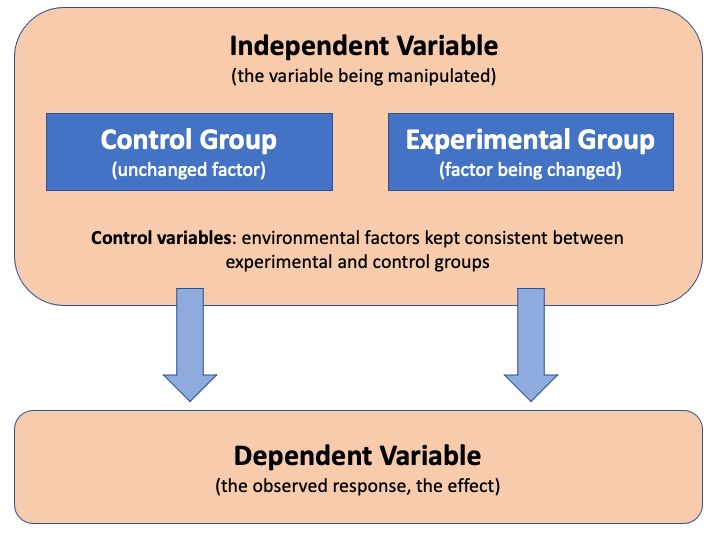
This labeled diagram summarizes the core logic of an experiment: the independent variable is manipulated, the dependent variable is measured, and control variables are held constant to reduce confounds. It also visually reinforces the comparison between control and experimental groups, which is fundamental for making cause-and-effect claims. Source
Experiment: A research method in which a researcher manipulates an independent variable and measures its effect on a dependent variable under controlled conditions.
The main strength of experiments is high control. Researchers can standardize procedures and reduce unwanted influences, making it easier to identify causal relationships. This makes experiments especially useful when a clear hypothesis is being tested. However, experiments may create artificial situations that do not reflect real life. Participants may also change their behavior because they know they are being studied. Experiments usually produce quantitative data and are best chosen when explanation is more important than naturalism.
Observations
Observations are useful when psychologists want to study actual behavior rather than self-reported behavior.
Observation: A research method in which behavior is recorded systematically, either in a natural setting or in a controlled setting.
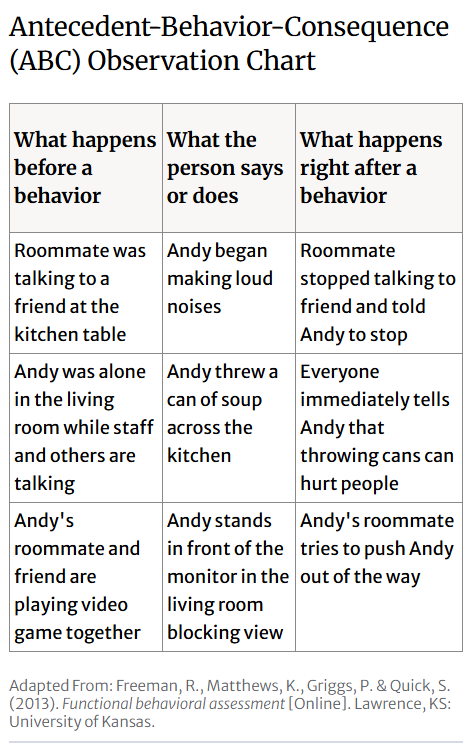
This ABC (Antecedent–Behavior–Consequence) chart shows one common way psychologists and behavioral researchers structure observational notes: what happened before a behavior, the behavior itself, and what happened immediately after. It highlights how observation can capture real-time, contextualized behavior data that participants may not accurately self-report. Source
Observations can capture behavior that participants may not notice, remember, or report accurately. This is a major advantage when studying nonverbal actions, group interactions, or spontaneous behavior. Naturalistic observations may have higher ecological validity because behavior is studied in a real context. However, observations usually offer less control than experiments, and the researcher may need to interpret behavior carefully. They also do not show causation. Observations are best chosen when the research focus is visible behavior rather than private thoughts or feelings.
Surveys
Surveys are often selected when a psychologist needs information from many people efficiently.
Survey: A research method that collects self-report data from participants, usually through questionnaires or rating scales.
Surveys are practical because they can gather large amounts of data quickly and in a standardized form. This makes comparison between participants easier. They are especially useful for studying attitudes, beliefs, opinions, and self-reported experiences. However, survey data depend on what participants choose to say. Responses may be affected by misunderstanding, guessing, or social desirability bias. Surveys usually produce quantitative data, although open-ended questions can add qualitative detail. They are best chosen when breadth is more important than depth.
Interviews
Interviews are chosen when psychologists need more detailed and flexible self-report data.
Interview: A research method in which a researcher asks participants questions directly in order to collect verbal data.
Interviews allow the researcher to clarify questions, ask follow-up questions, and explore answers in greater depth than a survey usually allows. This makes them valuable for complex, sensitive, or personal topics. Interviews often produce rich qualitative data, especially when they are semi-structured or unstructured. Their main limitations are that they are time-consuming, harder to standardize, and more affected by interviewer effects. Because of this, interviews are best chosen when depth and meaning matter more than speed or large sample size.
Correlational studies
Correlational studies are appropriate when psychologists want to examine whether two variables are related.
Correlational study: A research method that measures the strength and direction of a relationship between two variables without manipulating them.
A correlational study can show whether variables are associated, such as whether higher scores on one measure tend to occur with higher or lower scores on another. This method is useful when variables cannot be ethically or practically manipulated. It can also be valuable in early research when psychologists want to identify patterns before designing further studies. The key limitation is that correlation does not show causation.
A relationship may be influenced by a third variable, or the direction of influence may be unclear. Correlational studies are best chosen for investigating relationships, not causes.
Case studies
Case studies are selected when psychologists want a deep investigation of a single person, group, or situation.
Case study: A research method involving an in-depth investigation of one individual, small group, or unique event over time.
Case studies are especially useful for rare, unusual, or highly complex phenomena that cannot easily be studied through large-scale methods. They often combine several techniques, such as interviews, observations, and document analysis, to build a detailed picture. This produces rich information and can generate new ideas for later research. However, case studies usually have limited generalizability because findings from one case may not apply broadly. They may also be affected by researcher interpretation. Case studies are best chosen when uniqueness and depth are central.
Comparing methods when making a choice
A simple way to differentiate these methods is to ask what the researcher most needs:
Cause and effect: choose experiments
Directly observed behavior: choose observations
Large amounts of self-report data: choose surveys
Detailed personal accounts: choose interviews
Relationships between variables: choose correlational studies
Deep analysis of a rare or complex case: choose case studies
Another useful distinction is between breadth and depth. Surveys usually provide broad coverage across many participants, while interviews and case studies provide deeper insight into fewer participants. Observations focus on what people do, whereas surveys and interviews focus on what people say. Experiments and correlational studies both involve variables, but only experiments allow strong claims about causation because only experiments involve manipulation and control.
Practice Questions
(2 marks)
State two differences between an experiment and a correlational study.
1 mark for stating that an experiment involves manipulation of an independent variable and measurement of a dependent variable.
1 mark for stating that a correlational study measures the relationship between variables without manipulation and cannot establish causation.
(6 marks)
Explain why a psychologist might choose interviews rather than surveys to investigate patients' experiences of living with chronic pain.
1-2 marks for explaining that interviews produce richer, more detailed qualitative data.
1-2 marks for explaining that interviews allow follow-up questions, probing, and clarification.
1-2 marks for linking the choice to the complexity or sensitivity of personal experience, which fixed survey items may miss.
FAQ
A pilot study is a small trial run of a planned investigation before the full study begins.
It helps researchers see whether the chosen method actually works in practice. A pilot may show that survey questions are confusing, that an interview schedule is too long, or that an observation checklist misses important behavior. Because of this, researchers sometimes change methods entirely after piloting.
Using more than one method is helpful when one method alone would leave important gaps.
For example, a researcher might use a survey to identify patterns across many participants and then interviews to explore those patterns in more depth. This can improve confidence in the findings because different methods provide different kinds of evidence.
A low response rate means that many of the selected participants did not complete the survey.
This matters because the people who respond may differ from those who do not. If that happens, the survey results may give a distorted picture of the target population. High response rates do not guarantee accuracy, but they usually reduce the risk of this problem.
These forms differ mainly in how much control the researcher keeps over the conversation.
Structured: same questions in the same order for every participant
Semi-structured: prepared questions plus flexibility for follow-up
Unstructured: guided conversation with minimal fixed wording
Semi-structured interviews are often popular because they balance comparability with depth.
Yes. Researchers sometimes use archival data, meaning information that already exists, such as school records, medical files, diaries, or media reports.
In correlational studies, archival data can be used to examine relationships between variables without collecting new data. In case studies, archival material can help build a detailed history of a person or event. The main issue is that the researcher did not control how the original information was recorded.