IB Syllabus focus: 'Research methodology considers ethical effects and the role of external variables in drawing conclusions about causality.'
To evaluate psychological research well, students must understand both how researchers protect participants and how uncontrolled factors can weaken claims that one variable caused another.
Ethics in psychological research
Psychological studies involve people’s thoughts, emotions, and behavior, so ethical decision-making is central to research quality. Ethics is not just about avoiding harm; it also affects what researchers can study, how they collect data, and how confidently they can interpret results.
Ethics: Principles governing responsible research, especially the protection of participants’ rights, well-being, and dignity.
Ethical research protects participants while maintaining scientific value. In psychology, common ethical expectations include:
Informed consent: participants should know the nature of the study well enough to decide whether to take part.
Protection from harm: researchers must avoid causing physical or psychological harm beyond everyday levels.
Right to withdraw: participants should be free to leave the study at any time without penalty.
Confidentiality: identifiable personal information should be protected.
Deception limits: deception should be used only when necessary and justified.
Debriefing: after participation, researchers should explain the true purpose of the study and resolve any distress or confusion.
Why ethics affects findings
Ethical choices can change participant behavior and therefore influence results. For example:
If participants are fully informed, they may guess the aim and change their behavior.
If harmful procedures are avoided, the manipulation may be weaker, making effects harder to detect.
If deception is used, the study may feel more realistic, but participants’ trust may be affected.
This means ethics and methodology are linked: ethical safeguards may increase participant protection but also influence the strength or realism of the design.
External variables and causal conclusions
A researcher often wants to know whether an independent variable caused a change in a dependent variable. However, this is only convincing if other possible influences are controlled.
External variable: Any variable other than the independent variable that could affect the dependent variable.
If an external variable systematically changes with the independent variable, it may offer an alternative explanation for the results.
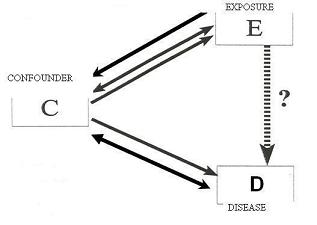
A confounding-variable diagram showing why causal claims weaken when a third variable is related to both the independent variable and the dependent variable. The arrows illustrate an alternative pathway that can explain the outcome even if the intended manipulation is not the true cause. Use this to justify why identifying and controlling confounds is essential for internal validity. Source
This weakens causal inference.
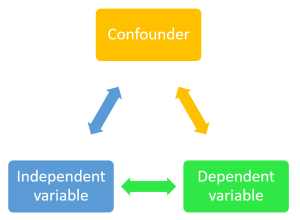
A triangle-style confounding diagram that highlights the key relationships needed for a variable to bias an observed IV–DV association. It emphasizes that confounding is not just “another variable,” but one that is connected to both the predictor and the outcome. This is a compact visual for explaining how spurious or masked effects can occur when external variables are not controlled. Source
Confounding variable: An external variable that varies with the independent variable and makes it unclear which factor caused the observed effect.
In research methodology, external variables are often grouped into broad categories:
Participant variables
These are differences between individuals that may influence outcomes, such as:
age
personality
intelligence
mood
prior experience
motivation
If one condition has more anxious participants than another, anxiety could influence the results rather than the intended manipulation.
Situational variables
These arise from the environment in which the study occurs, such as:
noise
room temperature
time of day
instructions given
presence of other people
Even small differences in setting can change behavior and reduce confidence in causal claims.
Researcher effects
Researchers may unintentionally influence participants through tone of voice, body language, expectations, or differences in how procedures are administered. This can create bias and introduce alternative explanations.
Causality and control
To argue that one variable caused another, researchers need strong evidence that:
the variables are related
the cause came before the effect
alternative explanations have been minimized
In psychology, experimental designs are usually strongest for causal conclusions because they involve manipulation and control. However, even experiments cannot prove causality well if external variables are not handled carefully.
A study with poor control may still find a difference between groups, but that difference may not be due to the independent variable. Instead, it may reflect a confound.
Common ways to control external variables
Researchers use several methods to reduce the impact of external variables:
Standardization: keeping instructions, timing, materials, and procedures as similar as possible for all participants.
Random allocation: assigning participants to conditions by chance, reducing systematic participant differences.
Counterbalancing: varying the order of conditions in repeated-measures designs to reduce order effects.
Matching: pairing participants on important characteristics before assigning them to groups.
Blinding: limiting knowledge of the hypothesis or condition to reduce researcher and participant expectancy effects.
Controlled settings: using the same room, equipment, and testing conditions for everyone.
Control improves internal validity, meaning the extent to which the study supports the claim that the independent variable caused the change in the dependent variable.
The relationship between ethics and control
Ethics and control sometimes support each other, but sometimes they create tension.
For example:
Allowing a full right to withdraw is ethically necessary, but if many participants leave one condition, the groups may become unequal.
Giving detailed information improves consent, but it may increase demand characteristics.
Avoiding stressful manipulations protects participants, but may reduce the strength of the independent variable.
Debriefing helps repair potential harm after deception, but the use of deception must still be carefully justified.
Researchers therefore make decisions that balance participant welfare with methodological rigor. Ethical review helps ensure that studies are both humane and scientifically defensible. When evaluating any study, a strong response should ask two linked questions: Were participants treated ethically? and Were external variables controlled well enough to support causal conclusions?
Practice Questions
State one way an external variable can affect conclusions about causality in a psychological study. [2]
1 mark for identifying that an external variable can influence the dependent variable.
1 mark for stating that this weakens or complicates the conclusion that the independent variable caused the effect.
Explain how ethical considerations and external variables may both influence a researcher’s ability to draw conclusions about causality. [6]
1–2 marks: Basic knowledge of either ethics or external variables, with limited explanation.
3–4 marks: Describes relevant ethical considerations and external variables with some explanation of how they affect causal conclusions.
5–6 marks: Clear explanation of both areas, showing that:
ethical requirements can shape or limit procedures
external variables can create alternative explanations
strong causal conclusions require both ethical practice and effective control of confounds
FAQ
An ethics committee usually asks whether deception is truly necessary and whether the same aim could be achieved without it.
It will also consider:
the level of possible distress
whether participants’ rights are still respected
whether a full debriefing is planned
whether participants can withdraw their data afterward
Deception is more likely to be approved when the risk is low and the scientific value is clear.
Yes. A study may fully protect participants but still fail to control important external variables.
For example, researchers might:
use informed consent appropriately
protect confidentiality
allow withdrawal
But if testing conditions differ across groups or instructions are inconsistent, causal conclusions remain weak. Ethical quality and methodological quality are related, but they are not the same thing.
Attrition means participants drop out before the study is completed. This matters if dropout is uneven across conditions.
If one group loses more participants, the remaining sample may no longer be comparable. That creates a possible confound, especially in longer or more stressful studies.
Researchers often track attrition patterns closely to judge whether the final results may be biased.
Not always. In some public settings, covert observation may be considered ethically acceptable if:
behavior is genuinely public
no personal identities are recorded
there is minimal risk of harm
the research cannot be done realistically with informed consent
Still, covert methods are usually reviewed very carefully because privacy expectations can be difficult to judge.
A pilot study is a small-scale trial run conducted before the main research.
It can help researchers:
spot confusing instructions
identify procedures that cause unnecessary stress
detect situational problems such as timing, noise, or equipment issues
estimate whether participants understand consent information
This makes the final study safer for participants and more controlled methodologically.