IB Syllabus focus: 'Reliability, validity, generalizability, reflexivity, transferability and credibility should be considered when evaluating research.'
Evaluating psychological research means asking not only what a study found, but also how trustworthy, accurate, and applicable those findings are across settings, samples, and methods.
Why research considerations matter
In IB Psychology, evaluating research involves judging the strength of evidence rather than simply describing results. A study may appear convincing, but its value depends on whether the methods produced dependable findings, whether the findings measured what they claimed to measure, and whether the conclusions can be applied beyond the immediate study. Different considerations are especially important in quantitative and qualitative research, although they can overlap.
Reliability, validity, and generalizability
Reliability
When a study is reliable, its procedures or measurements produce consistent results.
Reliability: The degree to which a research method, measure, or finding is consistent and repeatable.
Reliability matters because inconsistent measures weaken confidence in the findings. In psychology, reliability can involve whether a questionnaire gives similar scores over time, whether different observers record similar behaviors, or whether a procedure could be repeated with comparable outcomes. High reliability strengthens an argument that results are stable rather than random. However, reliability alone is not enough; a method can be consistent but still measure the wrong thing.
Validity
Researchers also need validity, which focuses on accuracy rather than consistency.
Validity: The extent to which a study, method, or measure actually measures what it claims to measure and supports accurate conclusions.
A study can be reliable but not valid. For example, a measure might consistently produce the same score while failing to capture the intended psychological concept. When evaluating validity, consider whether the design, measures, and interpretations genuinely match the research aim. Validity can also be limited if the research setting is too artificial, because behavior in a controlled setting may not reflect behavior in everyday life.
Generalizability
Quantitative research often asks whether findings extend beyond the specific participants studied.
Generalizability: The extent to which research findings can be applied to other people, settings, or times beyond the original study.
Generalizability depends partly on the sample and context.
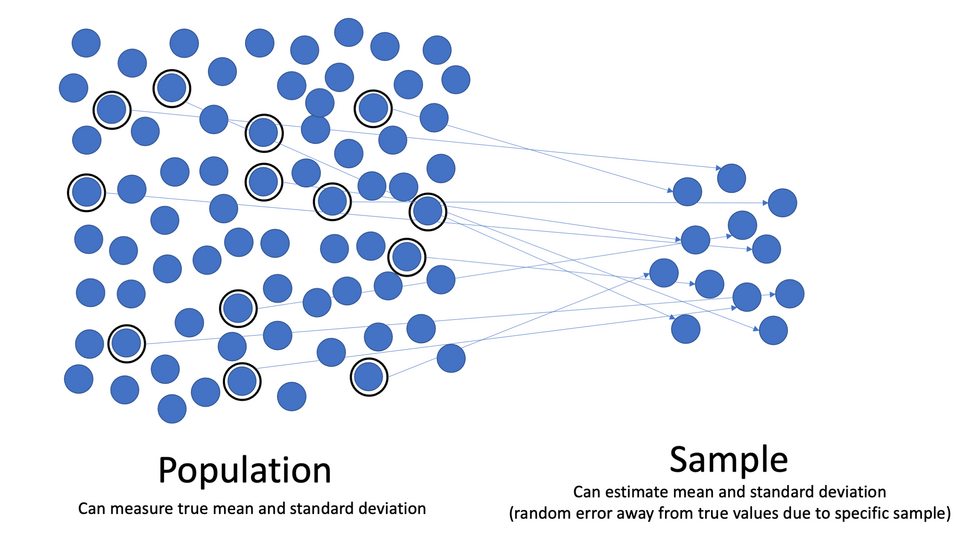
This diagram shows the relationship between a population (the full group a researcher wants to understand) and a sample (the subset actually studied). It helps illustrate why generalizability is always constrained by who was included in the sample and how that sample was selected. Source
Findings based on a narrow or unusual group may be less useful for explaining wider human behavior. When evaluating generalizability, ask:
Was the sample large enough and relevant to the target population?
Were the participants similar to the group the researcher wants to explain?
Was the context so specific that the results may not apply elsewhere?
A highly controlled study may have strong structure but limited generalizability if real-life situations differ greatly.
Reflexivity, transferability, and credibility
Reflexivity
In qualitative research, the researcher is often closely involved in collecting and interpreting data. This makes reflexivity essential.
Reflexivity: The researcher’s ongoing awareness of how their own background, assumptions, values, and presence may influence the research process and interpretation.
Reflexivity does not mean eliminating all researcher influence, which is often impossible. Instead, it means recognizing and openly discussing that influence. A reflexive researcher may consider how their relationship with participants, cultural position, or expectations shaped the questions asked and the meanings drawn from responses. This increases transparency and helps readers judge the quality of the interpretation.
Transferability
Qualitative researchers usually do not aim for broad statistical generalization. Instead, they consider transferability.
Transferability: The extent to which findings from one qualitative study may be meaningful or applicable in another context, as judged by the reader using detailed contextual information.
Transferability depends on how clearly the researcher describes the participants, setting, and process. Rich detail allows others to decide whether the findings may apply to a different but comparable context. Unlike generalizability, transferability is not about claiming that findings represent a whole population. It is about whether insights may reasonably carry over to similar situations.
Credibility
Another key issue in qualitative research is credibility, which concerns whether the interpretation is believable and well supported.
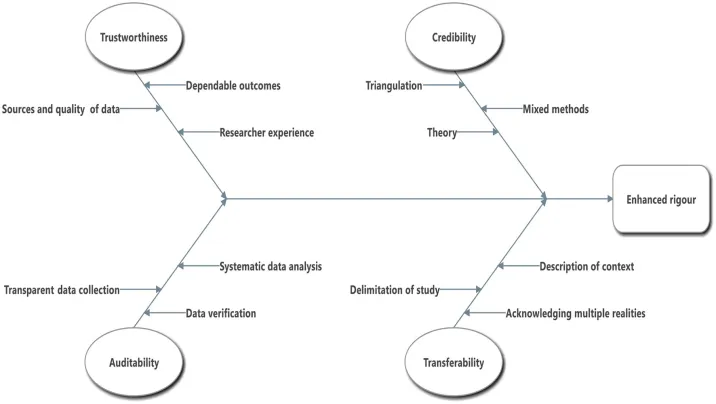
This model summarizes key dimensions used to judge rigor in qualitative research, explicitly including credibility and transferability. As a conceptual map, it helps students connect each criterion to what researchers must demonstrate (e.g., believable interpretations and sufficient contextual detail for readers to judge applicability). Source
Credibility: The extent to which qualitative findings are trustworthy, convincing, and grounded in the data collected.
Credibility is strengthened when the researcher shows clear links between the data and the conclusions. If themes or interpretations seem unsupported, overly selective, or shaped mainly by researcher assumptions, credibility is reduced. Researchers can improve credibility by carefully documenting how interpretations were developed and by showing that they are rooted in participants’ accounts rather than guesswork.
Applying these ideas in evaluation
Strong evaluation in IB Psychology compares a study’s strengths and limitations using the most relevant considerations. Not every concept applies equally to every method. For example:
In an experiment, reliability, validity, and generalizability may be central.
In an interview-based study, reflexivity, transferability, and credibility may be more appropriate.
Some studies can be evaluated using both sets of ideas, especially mixed-method designs.
A balanced evaluation should also recognize trade-offs:
Highly standardized methods may improve reliability but reduce natural behavior, which may limit validity.
Deep, detailed qualitative work may improve credibility and transferability but involve small samples, limiting generalizability.
Researcher involvement can enrich understanding but increases the need for reflexivity.
The key skill is to explain why a consideration matters for the specific study. Simply stating that a study has “low validity” or “high credibility” is weaker than linking the point to the design, sample, context, or interpretation. Effective evaluation shows that research quality is multidimensional: trustworthy findings depend on more than one criterion, and different methods are judged using different but equally important standards.
Practice Questions
(2 marks) Define credibility in qualitative research.
1 mark for identifying credibility as the trustworthiness or believability of qualitative findings.
1 mark for stating that the findings must be grounded in the data or supported by participants’ accounts.
(6 marks) Explain how reliability, validity, and generalizability can be used to evaluate one quantitative study in psychology.
1 mark for accurately explaining reliability.
1 mark for applying reliability to the chosen quantitative study.
1 mark for accurately explaining validity.
1 mark for applying validity to the chosen quantitative study.
1 mark for accurately explaining generalizability.
1 mark for applying generalizability to the chosen quantitative study.
FAQ
Both are types of reliability, but they check different sources of consistency.
Inter-rater reliability asks whether different observers or coders agree when recording the same behavior or response.
Test-retest reliability asks whether the same measure gives similar results when used again at a later time.
Inter-rater reliability is especially important in observational research and content analysis.
Test-retest reliability is especially useful for questionnaires and scales that are supposed to measure stable traits or attitudes.
A large sample helps, but it does not automatically solve all problems.
A study may still have weak generalizability if:
the sample is drawn from only one culture, age group, or social background
participants are self-selected and unusual in motivation
the setting is highly artificial
the behavior studied depends heavily on a specific historical or social context
Generalizability depends on both who was studied and where the research took place, not just how many participants were included.
Researchers often make reflexivity visible by showing how they monitored their own influence during the study.
This can include:
a short positionality statement
notes about assumptions held before data collection
reflections on how relationships with participants developed
explanations of how coding decisions changed over time
acknowledgment of emotional reactions or possible bias
The point is not to remove the researcher from the process. It is to make their role more transparent so readers can better judge the interpretation.
Both can strengthen credibility, but they work differently.
Member checking involves asking participants to review interpretations, transcripts, or themes to see whether they feel accurately represented.
Triangulation involves comparing multiple sources, researchers, methods, or types of data to see whether similar conclusions emerge.
Member checking focuses on participants’ perspectives.
Triangulation focuses on cross-verifying evidence.
A study may use one, both, or neither, depending on the design and research question.
Transferability is more useful when the goal is deep contextual understanding rather than broad statistical claims.
This often happens in:
case studies
interviews
ethnographic work
small-sample research on specific communities or experiences
In these cases, the value of the study comes from rich detail. Readers can then judge whether the findings might fit another setting with similar features.
So transferability is especially helpful when context matters so much that broad population-level conclusions would be misleading.