IB Syllabus focus: 'Students should understand thematic analysis as a process for identifying patterns in textual data and grouping them into themes.'
Thematic analysis is a flexible qualitative method used to make sense of written or spoken data. It helps psychologists move from raw responses to organized, meaningful patterns.
Thematic analysis: A qualitative method for identifying, organizing, and interpreting recurring patterns of meaning in textual data.
What It Does
In psychology, thematic analysis is used when researchers want to understand experiences, beliefs, attitudes, or perceptions through language. Instead of reducing responses to numbers, it focuses on what participants say and how those responses connect across a dataset. The aim is to identify patterns that are meaningful for the research question.
Researchers may apply thematic analysis to:
interview transcripts
focus group discussions
open-ended survey responses
diaries, blogs, or written reflections
field notes that have been turned into text
A pattern in thematic analysis is not just a repeated word. It is a repeated idea, experience, concern, or way of making sense of something. This means the researcher must look beyond isolated comments and consider how different pieces of data relate to one another.
Why It Is Useful in Psychology
Psychologists use thematic analysis because it can capture the richness of human experience. It is especially helpful when the goal is to explore how people understand issues such as stress, relationships, health, identity, or social experiences. It is also flexible enough to be used with small interview studies or larger collections of open-ended responses, as long as the procedure remains systematic.
Building Patterns from the Data
The process usually begins with codes, which mark important features of the data.
Code: A brief label attached to a segment of data that captures something relevant or meaningful.
Codes are narrow and specific, and there are often many of them in the early stages of analysis.
These codes are later grouped into themes.
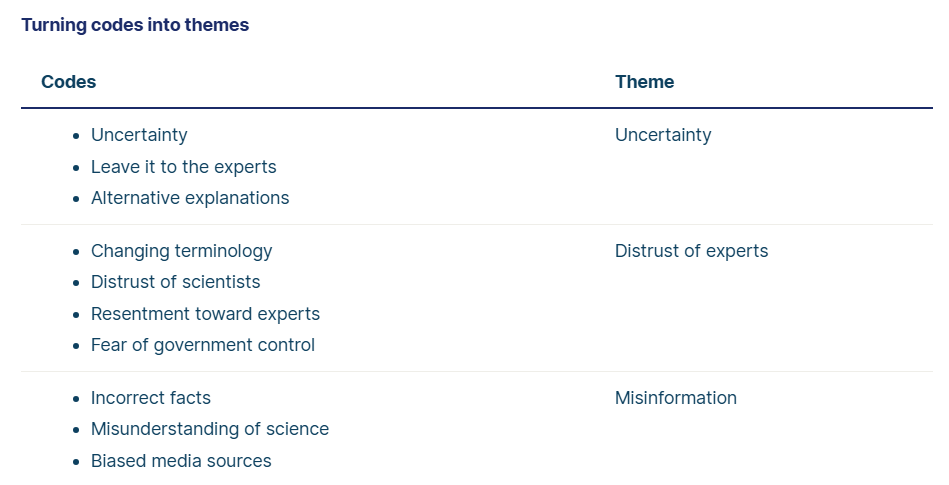
This worked example table demonstrates how several specific codes can be combined into broader, more abstract themes. It helps clarify that themes are interpretive patterns across the dataset, not just repeated words or a simple list of topics. Source
Theme: A broader pattern created by grouping related codes together into a meaningful category.
A theme is more than a simple topic label. It should capture something psychologically important about the dataset. For example, codes such as feeling judged, hiding emotions, and avoiding discussion might be grouped into a broader theme about social pressure. In this way, thematic analysis moves from detailed pieces of data toward larger patterns of meaning.
The Process of Thematic Analysis
Although researchers may describe the stages slightly differently, thematic analysis is usually carried out in a structured sequence.
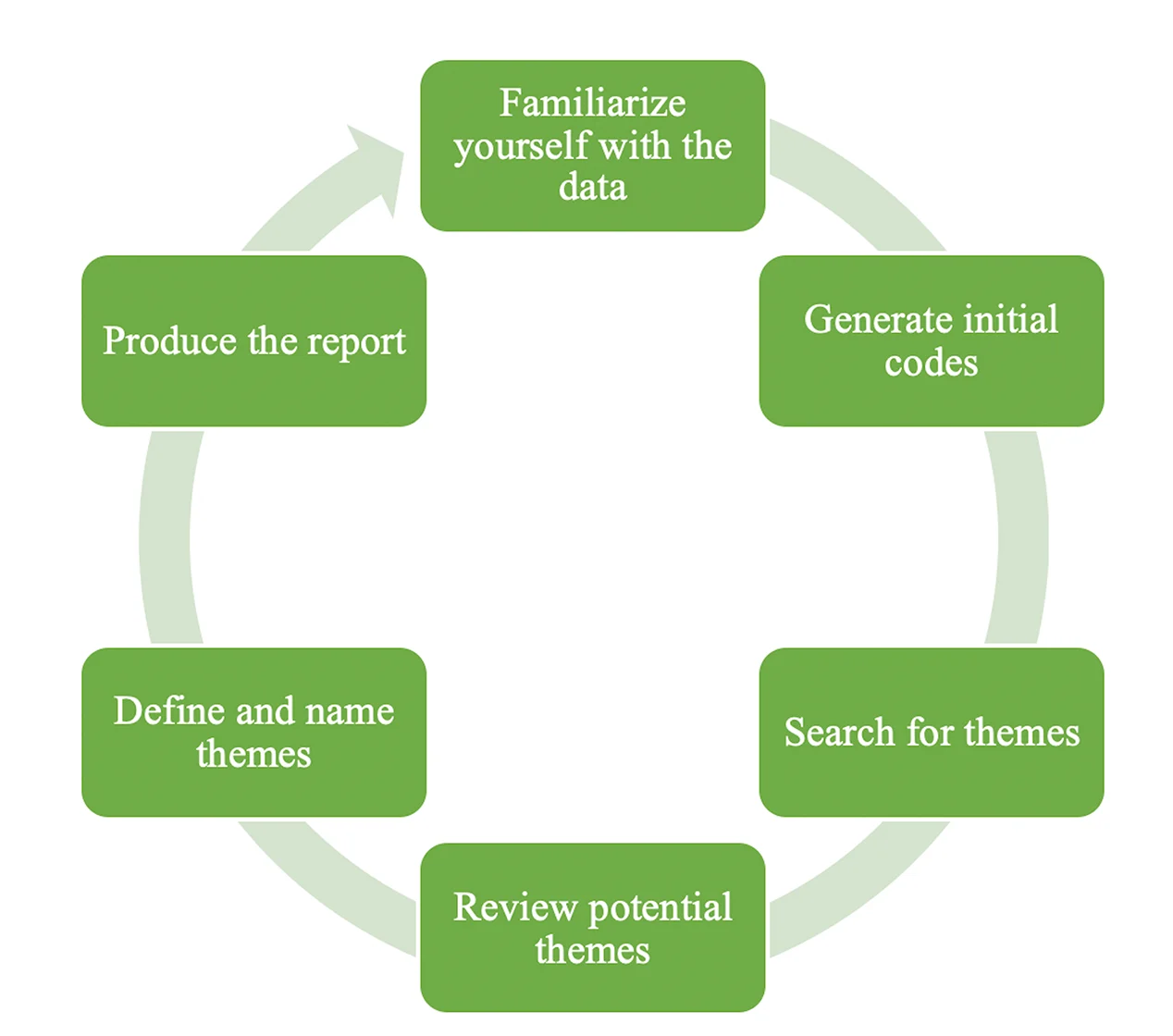
This diagram summarizes thematic analysis as a six-phase cycle, showing how researchers move from familiarization and initial coding toward theme development and final reporting. The circular layout emphasizes that qualitative analysis is iterative, with researchers revisiting earlier phases as their interpretation becomes more refined. Source
1. Familiarization with the data
The researcher reads and rereads the dataset carefully. If the data come from recordings, they may first be transcribed. At this stage, the aim is to notice repeated ideas, contradictions, tone, and possible patterns before trying to classify them. Strong familiarization reduces the risk of superficial analysis.
2. Initial coding
The researcher works through the dataset and labels relevant segments with codes. Coding should be systematic, meaning attention is given to the whole dataset rather than only to striking or memorable comments. A single extract can receive more than one code if it contains several important ideas.
3. Searching for themes
Once many codes have been created, the researcher looks for connections among them. Related codes are clustered together into possible themes. This stage shifts the analysis from many small details toward broader patterns. Not every code will become part of a final theme.
4. Reviewing themes
Potential themes must be checked against the data. The researcher asks whether the extracts within a theme really fit together and whether different themes are clearly distinct from one another. Some themes may be merged, split, renamed, or removed if the evidence is too weak.
5. Defining and naming themes
Each theme is then refined so that its meaning is clear. The researcher identifies what is central to the theme and how it helps answer the research question. Theme names should be specific and informative rather than vague, because precise labels make the analysis easier to understand.
6. Writing up the analysis
The final stage is to present the themes in a clear, logical account. The researcher explains each theme and supports it with evidence from the data. A strong write-up shows how the themes were developed and why they matter, rather than simply listing categories.
What Makes a Strong Thematic Analysis
A strong thematic analysis is systematic, evidence-based, and clearly linked to the research question. The goal is not to force the data into convenient labels but to represent meaningful patterns accurately.
Useful features include:
careful reading of the entire dataset
consistent coding across participants or responses
themes supported by enough relevant extracts
clear distinction between one broader pattern and another
theme names that communicate meaning clearly
Common Mistakes to Avoid
Students often confuse frequency with importance. A theme does not have to be the most common point in the dataset; it has to be meaningful for the question being asked.
Other common mistakes include:
using categories that are too broad to be useful
turning single comments into full themes without enough support
repeating codes as if they were themes
ignoring data that challenge the first interpretation
describing responses without identifying any wider pattern
Practice Questions
Define thematic analysis. [2 marks]
1 mark for identifying it as a qualitative method or process.
1 mark for stating that it identifies patterns in textual data and groups them into themes.
Explain the main steps involved in thematic analysis. [6 marks]
1 mark for explaining familiarization with the data.
1 mark for explaining initial coding.
1 mark for explaining the search for connections among codes.
1 mark for explaining the development of possible themes.
1 mark for explaining the review, refinement, or naming of themes.
1 mark for explaining the final write-up supported by data extracts.
Credit answers that describe the stages accurately even if wording differs.
FAQ
A semantic theme is based on what participants directly say. The researcher stays close to the explicit wording and identifies patterns at the surface level of meaning.
A latent theme goes deeper. It looks for underlying assumptions, ideas, or social meanings behind what is said. For example, a response might not directly mention power, but the researcher may identify power relations as an underlying pattern.
In inductive thematic analysis, the themes are developed mainly from the data itself. The researcher does not begin with a fixed set of categories.
In deductive thematic analysis, the researcher starts with a theory, concept, or focused question and looks for data related to it. Neither approach is automatically better; the best choice depends on the research aim and how open or focused the analysis needs to be.
No. Thematic analysis can be done by hand using printed transcripts, notes, and highlighting, or digitally with spreadsheets and word processors.
Specialized qualitative software can help researchers:
store large datasets
organize codes
retrieve all extracts linked to a code
keep an audit trail of analytic decisions
However, software does not interpret the data for the researcher. The analysis still depends on human judgment.
There is no fixed number that automatically makes a thematic analysis strong. What matters is whether the dataset is rich enough to answer the research question meaningfully.
A smaller sample may be enough if the data are detailed and the study is focused. A larger sample may be needed if responses are brief or the topic is broad. Researchers usually judge adequacy by the depth, relevance, and consistency of the material rather than by numbers alone.
Yes. Thematic analysis involves interpretation, so different researchers may notice different patterns or give themes different labels.
That does not mean the analysis is unreliable. Different interpretations can still be valid if they are well supported by the data and clearly explained. Good practice includes keeping detailed coding notes, explaining analytic choices, and showing evidence from the dataset so readers can see how the themes were developed.