IB Syllabus focus: 'Students should evaluate self-selected, opportunity, stratified, random and snowball sampling techniques.'
Sampling affects who enters a study and how far findings can be generalized. In IB Psychology, evaluation means judging each technique by its usefulness, bias, practicality, and likely impact on research quality.
Why sampling matters
Psychologists usually cannot study every member of a target population, so they select a sample instead. The way that sample is chosen matters because it influences representativeness, the amount of bias in the study, and whether findings can be generalized beyond the participants actually tested.
Sampling technique: The method used to select participants from a target population for a study.
When evaluating sampling, it is important to ask not only whether the method is convenient, but also whether it fits the research aim. Some techniques are fast and inexpensive, while others are stronger for producing a balanced sample.
Key criteria for evaluation
Representativeness: Does the sample reflect the main characteristics of the target population?
Bias: Does the method make some people more likely to be selected than others?
Practicality: Is the method realistic in terms of time, cost, and access?
Generalizability: Can the findings reasonably be applied to the wider population?
Suitability: Is the technique appropriate for the specific group being studied?
Main sampling techniques
Self-selected sampling
In self-selected sampling, participants volunteer to take part after seeing an advertisement, online post, email invitation, or similar recruitment message. This method is common in surveys and internet-based research.
A major strength is that it is efficient. Researchers can reach many possible participants quickly, and volunteers have already shown willingness to participate, which may improve completion rates. It also supports informed consent because people actively choose to join.
A major limitation is volunteer bias.
People who volunteer may differ from those who do not. They may have stronger opinions, more free time, greater confidence, or more interest in psychology. This can reduce representativeness and weaken generalizability. Self-selected samples are therefore practical, but often less balanced than probability-based methods.
Opportunity sampling
In opportunity sampling, researchers choose participants who are available at the time and place of the study. This may include students in a classroom, people in a hallway, or individuals already present in a setting.
Its main advantage is speed. It is usually cheap, easy to organize, and useful when researchers have limited resources. For small-scale studies, this can make data collection possible when more complex methods are unrealistic.
However, opportunity samples are often narrow and biased toward accessible people. The sample may reflect one location, one time of day, or one social group rather than the wider population. Because of this, opportunity sampling tends to have low representativeness. It is easy to use, but often weak if the aim is broad generalization.
Random sampling
In random sampling, every member of the target population has an equal chance of being selected. This reduces researcher choice in participant selection and helps limit selection bias.
Sampling frame: A list of all members of the target population from which a sample can be selected.
Random sampling usually requires a sampling frame. If the frame is accurate and selection is truly random, this method can produce a more representative sample than self-selected or opportunity methods. It is often seen as strong for quantitative research where generalization is important.
Its limitations are practical. A complete sampling frame may be difficult or impossible to obtain. The process may also take more time and organization than simpler techniques. In addition, a random sample is not automatically representative, especially if the sample is small or many selected people do not respond. Random sampling reduces bias, but it does not remove all sampling problems.
Stratified sampling
In stratified sampling, the target population is divided into relevant subgroups, called strata, such as age groups, gender categories, or other characteristics.
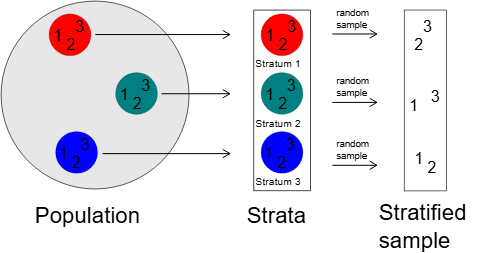
This diagram shows stratified sampling as a two-stage process: first partition the population into meaningful strata, then draw random samples within each stratum. Visually, it reinforces the core evaluation claim that stratification increases representativeness by preventing small-but-important subgroups from being missed, provided the strata are well-chosen. Source
Participants are then selected from each stratum, often in proportion to their presence in the population.
The main strength of stratified sampling is improved representativeness. Important subgroups are less likely to be missed, so the final sample may reflect the population more accurately than a simple random sample. This is especially useful when some groups are small but still important to include.
The main limitation is complexity. Researchers must know the composition of the population in advance and must choose appropriate strata. If the strata are poorly selected or population data are inaccurate, the method becomes weaker. Stratified sampling is often stronger than simple random sampling for balanced representation, but it is more demanding to carry out correctly.
Snowball sampling
In snowball sampling, existing participants recruit other participants from their own social networks.
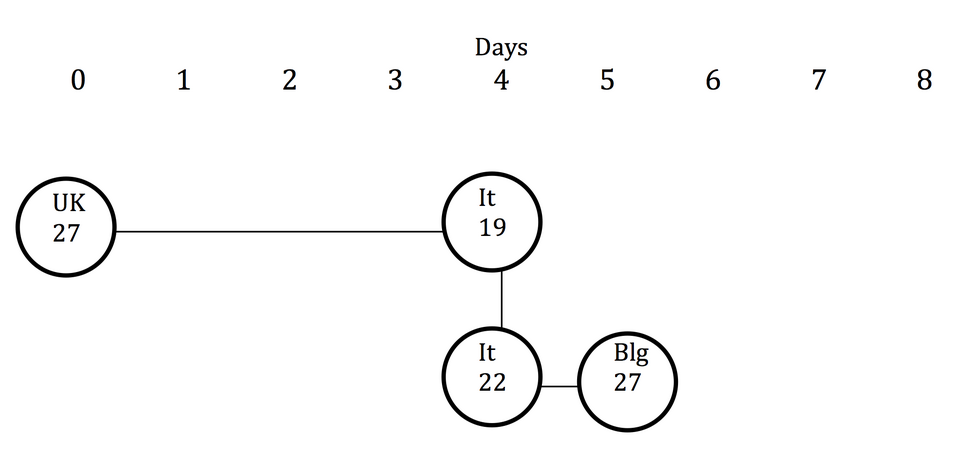
This diagram visualizes snowball (chain-referral) sampling as a recruitment network that expands outward from initial “seed” participants. It helps explain why snowball sampling can efficiently reach hidden populations, while also illustrating how reliance on social ties can concentrate the sample within a few connected clusters (network bias). Source
The sample grows gradually through participant referrals.
This technique is especially useful for hard-to-reach or hidden populations, where no sampling frame exists and trust is important. It can help researchers access groups that are difficult to contact through ordinary methods.
Its main weakness is network bias. Participants often recruit people similar to themselves, which can make the sample unusually homogeneous. This reduces representativeness and can limit generalizability. Snowball sampling may also raise confidentiality concerns because recruitment depends on social connections. It is valuable for access, but usually weak for producing a broad cross-section of a population.
Comparing techniques in evaluation
No sampling technique is always best. The best choice depends on the research aim and the population being studied. If a study needs fast recruitment, opportunity or self-selected sampling may be justified. If the goal is stronger generalization, random or stratified sampling is usually better. If the group is hidden or difficult to identify, snowball sampling may be the most realistic option.
Common exam judgments
In IB answers, evaluation should go beyond naming strengths and weaknesses. Explain why a strength matters and how a limitation affects research quality. Strong responses use terms such as representativeness, bias, generalizability, sampling frame, and practicality accurately. They also compare methods rather than treating one technique as simply good or bad in all situations.
Practice Questions
(2 marks) State two characteristics of stratified sampling.
1 mark for stating that the population is divided into relevant subgroups or strata.
1 mark for stating that participants are selected from each stratum, often in proportion to the population.
(6 marks) Evaluate two sampling techniques used in psychological research.
1 mark for accurately identifying and describing the first sampling technique.
1 mark for one clear strength of the first technique linked to research quality.
1 mark for one clear limitation of the first technique linked to research quality.
1 mark for accurately identifying and describing the second sampling technique.
1 mark for one clear strength of the second technique linked to research quality.
1 mark for one clear limitation of the second technique linked to research quality.
Credit only evaluation relevant to sampling, such as representativeness, bias, practicality, access, or generalizability.
FAQ
Researchers cannot remove volunteer bias completely, but they can reduce it by improving recruitment design.
Use neutral wording in advertisements so the study does not appeal mainly to one type of person.
Recruit through several channels rather than one platform.
Compare sample demographics with the target population.
Offer modest incentives that encourage participation without attracting only highly motivated volunteers.
These steps improve balance, even if the sample is still self-selected.
Snowball sampling can create extra confidentiality risks because participants may identify other potential participants.
Researchers should:
Ask current participants to share study information rather than names whenever possible.
Make sure referrals understand participation is voluntary.
Avoid revealing who has already taken part.
Use separate consent procedures for each new participant.
This helps prevent pressure, unwanted disclosure, and loss of privacy.
Strata should be based on variables that matter for the population or the research question.
Researchers often choose strata by:
Looking at census or institutional data
Identifying characteristics linked to the topic
Selecting categories that are clear and measurable
Too many strata can make sampling difficult, while poorly chosen strata add complexity without improving representativeness.
An incomplete sampling frame creates coverage error, meaning some members of the population have no chance of being selected.
This can happen if:
Contact lists are old
Some groups are missing
The population changes quickly
Even a random or stratified method becomes weaker if the frame is flawed, because the sample can only represent the people who were actually included on the list.
Yes. In practice, researchers sometimes combine methods to solve access problems.
For example:
They may use stratified sampling first, then random sampling within each stratum.
They may begin with opportunity sampling and later expand through snowball recruitment.
They may use self-selected recruitment but then screen participants to balance the sample.
When evaluating a mixed approach, explain which part improves practicality and which part may still introduce bias.