IB Syllabus focus: 'Research methodology includes research methods, sampling techniques, procedures, data collection and analysis across the course.'
Research methodology is the framework that allows psychologists to investigate behavior systematically.

This visual presents research as a structured workflow that connects planning, analysis, and application. Used alongside your definition of methodology, it can help students remember that methods, procedures, sampling, and analysis function together as an integrated system rather than isolated steps. Source
Across the IB course, it helps students understand how studies are designed, how evidence is produced, and how findings should be interpreted.
Why research methodology matters
Psychology depends on evidence-based claims. Research methodology provides the tools for asking questions, collecting information, and deciding whether conclusions are justified. It is not a separate skill used only in one unit; instead, it runs across the course because every psychological claim is supported by some kind of research process.
When reading any study, students should ask:
What method was used?
Who participated and how were they selected?
What procedure was followed?
How was data collected?
How was data analyzed?
Do the conclusions match the evidence?
These questions help students move beyond memorizing findings and instead evaluate the quality of the evidence behind them.
What research methodology includes
At its broadest level, research methodology covers the planning, conduct, and interpretation of research.
Research methodology: The overall system of methods, procedures, sampling, data collection, and analysis used to investigate a research question.
This means methodology is more than just naming a research method. It includes the full structure of a study, from the initial question to the final interpretation.
Research methods
A research method is the general strategy used to study behavior or mental processes. Across psychology, methods are chosen based on the nature of the question being asked. Some methods are better for identifying possible cause-and-effect relationships, while others are better for exploring experiences, attitudes, or naturally occurring behavior.
Method choice matters because it shapes:
the kind of data collected
the level of control in the study
the kinds of conclusions that can be made
the strengths and limitations of the evidence
A strong methodological understanding means recognizing that no single method is always best. The value of a method depends on how well it fits the research aim.
Sampling techniques
Research findings depend heavily on the sample, meaning the group of participants studied.
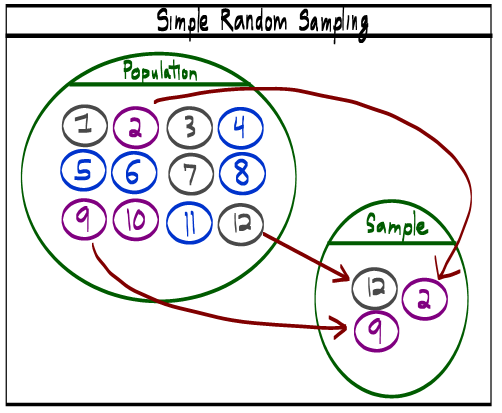
This diagram illustrates the core logic of probability sampling: selecting a subset (the sample) from a larger group (the population). It helps explain why sampling choices influence bias and generalizability—if the sample is not representative, conclusions may not extend beyond the participants studied. Source
Sampling techniques affect whether a study includes a narrow or broad range of people and whether the findings may be applied beyond the sample itself.
Sample: The group of participants selected from a larger population to take part in a study.
Sampling matters because participants are rarely chosen from the entire population. Psychologists must therefore think carefully about whether the sample is suitable for the study’s purpose and whether it may introduce bias. Across the course, sampling is important because it affects generalizability, or the extent to which findings may apply to other people or contexts.
Procedures in psychological research
A procedure is the step-by-step process used to carry out a study. Clear procedures are essential because they allow other researchers to understand exactly how the study was conducted.
Procedures often include:
instructions given to participants
the order of tasks or conditions
the setting in which the research takes place
the materials or measures used
how researchers record responses
Well-designed procedures support consistency. If procedures are vague or poorly controlled, it becomes harder to know whether the results are trustworthy. Across the course, students should pay attention to how procedures may influence participant behavior and, in turn, the study’s findings.
Operationalization
A key part of procedure is operationalization, meaning turning an abstract concept into something measurable.
Operationalization: Defining a variable in specific, observable, and measurable terms so it can be studied.
In psychology, many ideas such as stress, memory, or aggression are abstract. Researchers must decide exactly how these concepts will be observed or measured. Good operationalization improves clarity and makes studies easier to replicate.
Data collection
Data collection refers to the process of gathering information from participants or observations. The type of data collected depends on the research question and method.
Psychological research may collect:
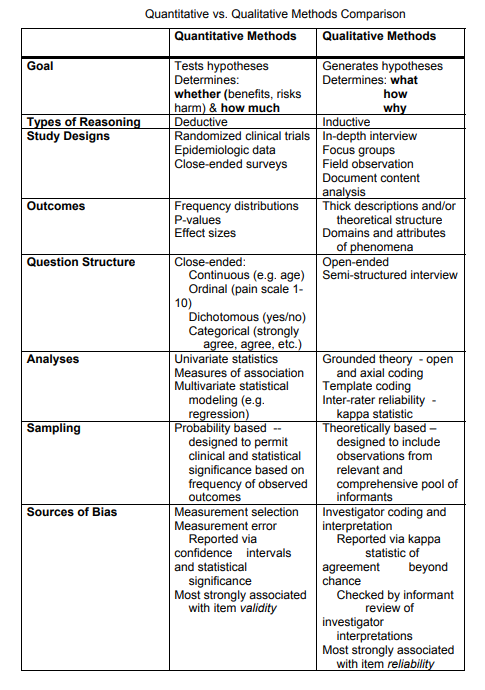
This table contrasts quantitative and qualitative approaches across goals, study designs, question types, analyses, and common sources of bias. It reinforces the idea that data collection is tied to how findings will be analyzed and what kinds of conclusions can reasonably be drawn from the evidence. Source
quantitative data, which is numerical
qualitative data, which is descriptive and expressed in words
Both types of data are useful. Quantitative data can show patterns, differences, or relationships in a structured form. Qualitative data can provide rich detail about meanings, experiences, and perspectives. Across the course, students should understand that data collection is not neutral: the way data is gathered influences what can later be analyzed and concluded.
Data collection also requires attention to:
clarity of measures
consistency across participants
minimizing researcher influence
recording responses accurately
Data analysis
Once data has been collected, it must be analyzed so that patterns can be identified and interpreted. Analysis is the stage where raw information becomes meaningful evidence.
For quantitative data, analysis often focuses on:
identifying trends or differences
comparing groups or conditions
summarizing results clearly
For qualitative data, analysis often focuses on:
identifying patterns in responses
grouping ideas into categories
interpreting meaning in context
Analysis should always match the type of data collected and the aims of the study. If analysis is inappropriate, even carefully collected data may lead to weak conclusions.
Methodology as a continuous skill
Across the IB Psychology course, research methodology should be treated as a continuous lens for understanding studies. Students are not only expected to know study findings, but also to explain how those findings were produced. This requires attention to method, sample, procedure, data collection, and analysis together rather than in isolation.
Methodological thinking helps students:
evaluate evidence critically
compare studies more effectively
understand why findings may differ
identify strengths and limitations in research design
In this way, research methodology is central to psychology because it connects theory, evidence, and interpretation in every area of the course.
Practice Questions
State two components of research methodology in psychology. [2]
Award 1 mark for each correctly identified component, up to 2 marks.
Acceptable answers include:
research methods
sampling techniques
procedures
data collection
data analysis
Explain why research methodology is important across the IB Psychology course. [6]
1–2 marks:
Demonstrates limited understanding of research methodology.
May identify one or two features without clear explanation.
3–4 marks:
Explains that research methodology includes method, sampling, procedures, data collection, and analysis.
Shows some understanding that methodology helps psychologists investigate behavior systematically.
May mention evaluation of evidence or quality of conclusions.
5–6 marks:
Clearly explains that research methodology is relevant across all areas of psychology because all claims depend on how studies are designed and conducted.
Explains multiple components such as method, sampling, procedures, data collection, and analysis.
Links methodology to interpretation of findings, critical evaluation, and judging whether conclusions are supported by evidence.
FAQ
Research methodology is the logic behind the whole investigation, not just the act of collecting results.
It includes:
why a method was chosen
how participants were selected
how variables were measured
how data was interpreted
So, “doing a study” is the practical activity, while methodology is the structured system that makes the study scientifically meaningful.
Detailed procedures make research transparent.
This helps other psychologists:
understand exactly what was done
evaluate whether the study was fair and consistent
repeat the study to check whether similar results appear
Without procedural detail, a finding may sound interesting but remain difficult to trust or build on.
Yes. Good data collection does not automatically lead to good conclusions.
For example, researchers may gather clear and relevant responses but:
analyze the wrong feature of the data
overlook important patterns
interpret results too broadly
That is why methodology includes both collection and analysis. Each stage must be appropriate for the study to be convincing.
Methodological language helps make evaluation precise.
Instead of saying a study was “good” or “bad,” students can comment on:
the suitability of the method
the adequacy of the sample
the clarity of the procedure
the appropriateness of the analysis
This produces stronger psychological arguments because it focuses on how evidence was actually generated.
Different conclusions may result from methodological differences rather than from the topic itself.
Possible reasons include:
different samples
different procedures
different ways of measuring the same concept
different forms of data analysis
This is why comparing methodology is essential. It helps explain whether findings truly conflict or whether they reflect different research designs.